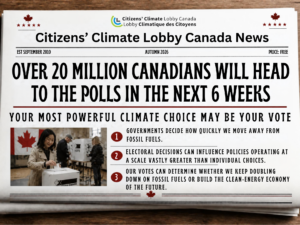
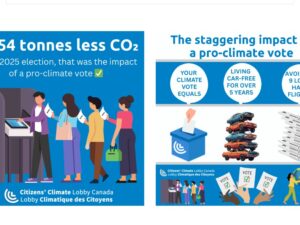
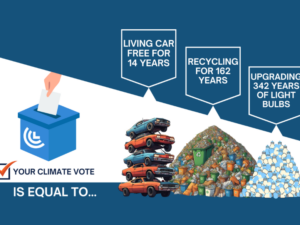
SUDBURY, ON, August 26, 2026: Canadians in Beaches-East York, Chicoutimi–Le Fjord and North Vancouver–Capilano will head to the polls on Monday, August 31, in three federal by-elections that could influence the political conditions under which Canada’s climate and energy policies are decided. The Liberal government currently holds 171 seats and would need 173 to secure a majority. The results of these by-elections could therefore affect the government’s ability to advance major policy initiatives and the influence that opposition parties, including the NDP, Bloc Québécois and Green Party, may have over the government’s climate and energy agenda. A change in the parliamentary balance could make it more difficult for the government to advance the controversial energy initiatives, such as the West Coast Pipeline and the weakened Pathways Carbon Capture project. But the climate significance of these by-elections goes beyond any single policy or party. Voting is one of the few actions individuals can take that can influence climate policy at the scale of government. A case study of the 2019 federal election estimated that votes cast for pro-climate candidates contributed to significant reductions in Canada’s future greenhouse gas emissions, approximately 100 megatonnes of CO₂ annually by 2030. The analysis estimated that the modeled emissions impact associated with each pro-climate vote amounted to 34.2 tonnes of CO₂ over the following 3.4 years, equivalent to the annual emissions of approximately 14 passenger vehicles. Our own analysis of the 2025 federal election similarly estimated that voting for pro-climate candidates could be associated with a potential reduction in Canada’s greenhouse gas emissions equivalent to approximately 13.5 tonnes of CO₂ annually per pro-climate voter until the next federal election. These figures should not be interpreted as a literal personal carbon reduction resulting from an individual vote. Rather, they illustrate the potential scale of the policy impact that can be associated with electoral choices. That distinction is important. Individual actions such as driving less, reducing energy use or changing consumption can reduce personal emissions. Political decisions can influence the rules, investments and infrastructure that shape emissions across entire sectors of the economy. The August 31 by-elections are therefore one part of a much larger opportunity for Canadians to influence climate policy through the ballot box. Three additional federal by-elections are expected to be called by early 2027 in Saint-Hyacinthe–Bagot–Acton, Scarborough North and Rosemont–La Petite-Patrie. Municipal elections are also taking place this fall in New Brunswick, British Columbia, Ontario, Manitoba, Prince Edward Island, Saskatchewan and the Northwest Territories, alongside the Quebec provincial election. Taken together, these elections represent an important opportunity for voters to influence Canada’s climate trajectory at the federal, provincial and local levels. Climate impacts are increasingly affecting food production and other aspects of daily life, while the prospect of an impending Super El Niño adds to growing concerns about climate risk. Eventually, something has to give. The question is whether that change will come through public pressure, political action, or both. Media Contact: Cathy Orlando, National Director, Citizens’ Climate Lobby Canada cathy@citizensclimate.org | 705-929-4043 Additional References: ##### Federal By-Elections on August 31: A Climate Crossroads
MEDIA RELEASE: Federal By-Elections on August 31: A Climate Crossroads
Posted on August 26, 2026 in Media Release