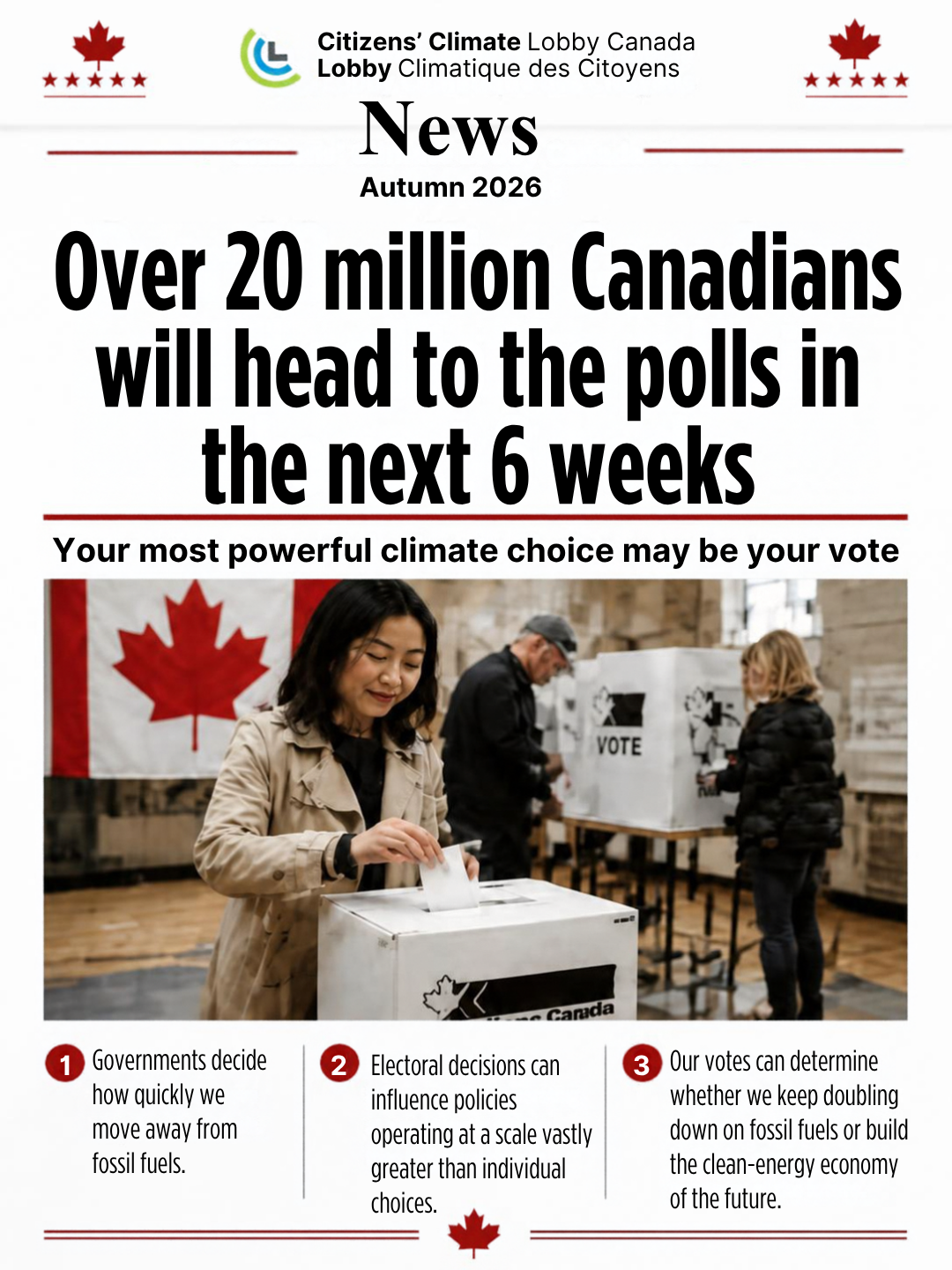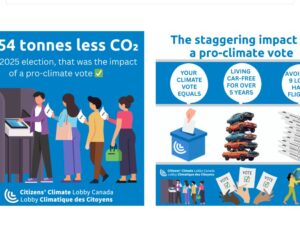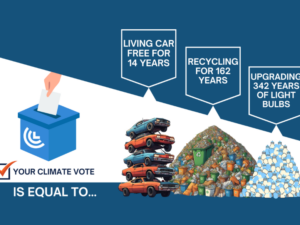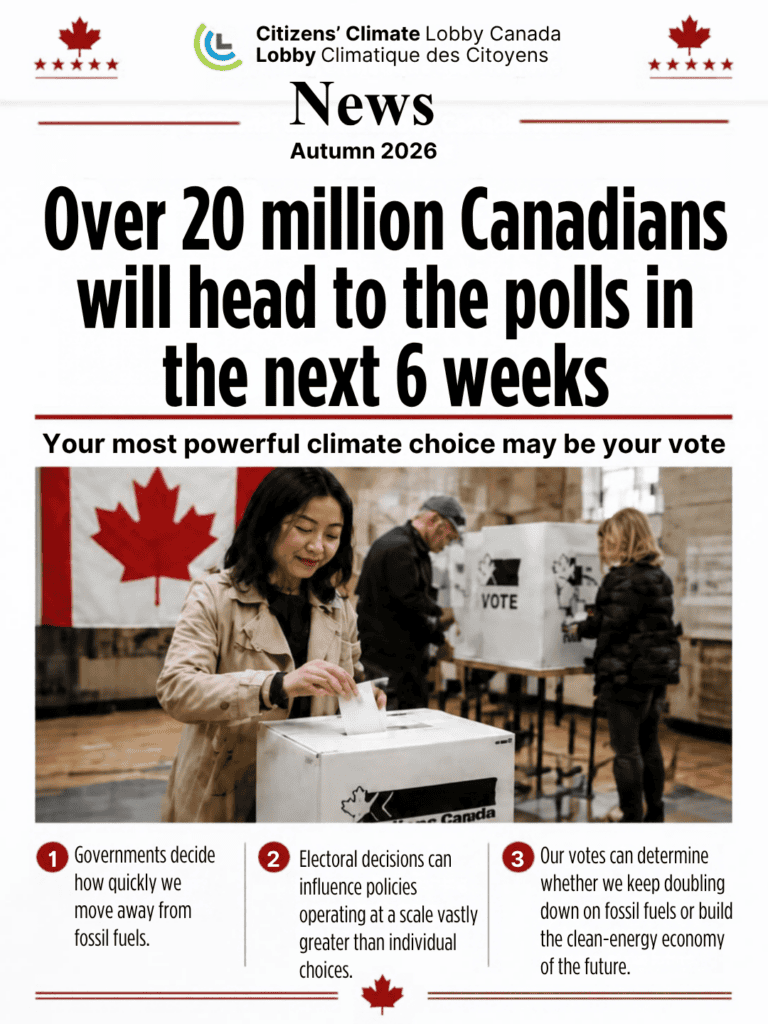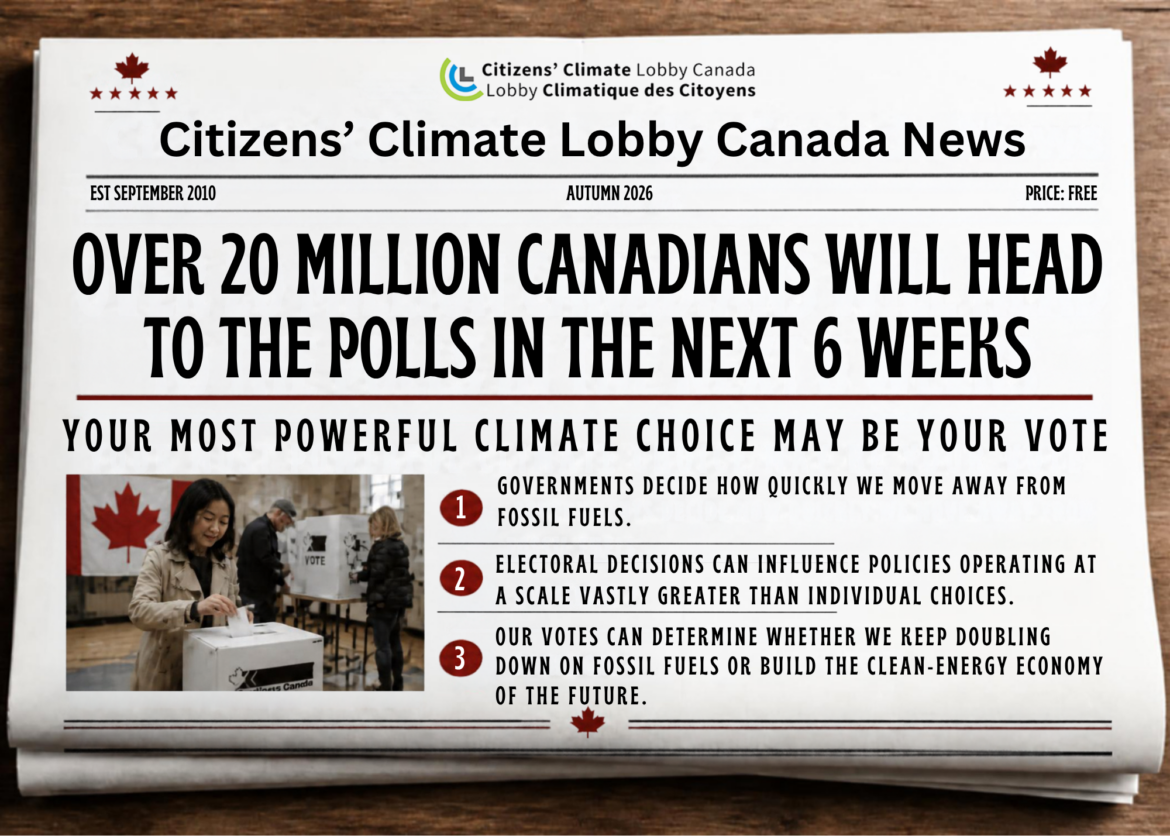
Media Contact: Cathy Orlando, National Director, Citizens’ Climate Lobby Canada cathy@citizensclimate.org | 705-929-4043 SUDBURY, ON in Robinson-Huron Treaty Territory, September 28, 2026 — Most people think about their climate impact in terms of what they buy, how they travel or how much energy they use. But another choice can have consequences far beyond an individual household: voting. Over the next six weeks, more than 20 million Canadians will have the opportunity to vote in provincial, municipal and referendum votes across the country. Quebec, and British Columbia will hold provincial elections while municipal elections will take place in British Columbia, Ontario, Manitoba, Prince Edward Island, Saskatchewan and the Northwest Territories. Alberta will also hold a referendum Additionally, seven federal seats are currently vacant, with by-elections still to be called: Scarborough North, Rosemont–La Petite-Patrie, Laurier–Sainte-Marie, Saint-Hyacinthe–Bagot–Acton, Yorkton–Melville, Brantford–Brant South and Muskoka-Parry Sound. That is an extraordinary number of opportunities for Canadians to participate in decisions shaping their communities, economies and climate future. But how can a vote affect climate change? Because governments decide how quickly we move away from fossil fuels. They shape energy systems, transportation, buildings, infrastructure and land use, determining whether we continue locking in fossil fuel emissions or accelerate the transition to cleaner energy. The Government of Canada says municipalities influence over 50% of greenhouse gas emissions via significant fossil-fuel-related decisions on transportation, buildings, land use and infrastructure. Provincial governments also make decisions about electricity, natural resources, building codes, transportation infrastructure and land-use planning. Those decisions can influence emissions for decades. Here is where your vote is powerful. A study of Canada’s 2019 federal election estimated that differences between the leading parties’ climate policies could have produced approximately 100 megatonnes less greenhouse gas emissions annually by 2030. Under the study’s assumptions, that amounted to approximately 34.2 tonnes of less greenhouse gases associated with each vote over the 3.4-year period examined. That does not mean an individual voter literally caused or prevented 34.2 tonnes of emissions. It is a modelling exercise allocating the potential difference between policy trajectories across electoral outcomes. Similarly, Citizens’ Climate Lobby Canada’s analysis of the 2025 federal election produced a different estimate, approximately 13.5 tonnes less of annual emissions associated with each vote for the modeled lower-emissions policy outcome, according to the parties’ platforms at that time. Compare that to living car-free (~2.4 tonnes/year) or skipping a long-haul flight (~1.6 tonnes). The message of both studies is the same: electoral decisions can influence policies operating at a scale vastly greater than individual consumer choices. So how do we turn concern about climate change into participation? The U.S.-based Environmental Voter Project has extensive research showing that the key to getting environmentalists to vote is surprisingly simple: normalize voting. Simply say to your friends, “I’m voting. Are you voting?” Its behavioural-science research shows that making voting a regular habit can turn occasional voters into consistent voters “Our votes matter,” says Cathy Orlando, Director of Citizens’ Climate Lobby Canada. “They can help determine whether we keep doubling down on fossil fuels or build the clean-energy economy of the future.” We often hear that fighting climate change is about making better individual choices: driving less, using less energy, buying differently. Those choices matter. But the rules governing our energy systems, transportation, buildings, infrastructure and economy are set through democratic decisions. That gives citizens a powerful lever. This fall, millions of Canadians have an extraordinary number of opportunities to use that lever. Your most powerful climate choice may not be what you put in your shopping cart or how you get to work. It may be what you do at the ballot box. ##### Updated September 30.Your Most Powerful Climate Choice May Be Your Vote
Your Most Powerful Climate Choice May Be Your Vote
Home » CCL Canada News » Your Most Powerful Climate Choice May Be Your Vote