What we do…
We lobby in support of our evidence-based climate policies by building friendly relationships with our federally elected representatives. We do so with respect, appreciation and gratitude for their service.
We write letters to the editor and op-eds, and meet with editorial boards to gain their editorial endorsement.
We facilitate presentations and table at events to promote CCL and introduce others to our Carbon Fee and Dividend proposal.
We support our volunteer chapters with monthly conference calls, and we support the leaders of those chapters with regular conference calls and a network of people to support them.
What we believe…
Politicians don’t create political will, they respond to it. We believe citizens who are well-trained, organized by Ridings and with a good system of support can more than influence the political process.
In respect for all viewpoints, even for those who would oppose us.
Based on what climate scientists and economists tell us, we believe that Climate Income is the best first step to reduce greenhouse gas emissions and to mitigate the impacts of a changing climate and we have plenty proof for that!
All politics is local. Thus we build political will for a liveable world by building relationships locally with our politicians, community leaders and local media as well as educating our community. The resources below will help you get started:
Brochures, Pamphlets and More
Brochures, Sign-Up Sheets and More
 |
Small pamphlet, four images per page with a front and a back in png format. | February 2026 |
 |
General CCL trifold brochure in English (2026) in Word. Feel free to edit for your local context. | Updated February 2026 |
 |
Display poster (png) with QR code to our website and generic explanation about who we are. | February 2026 |
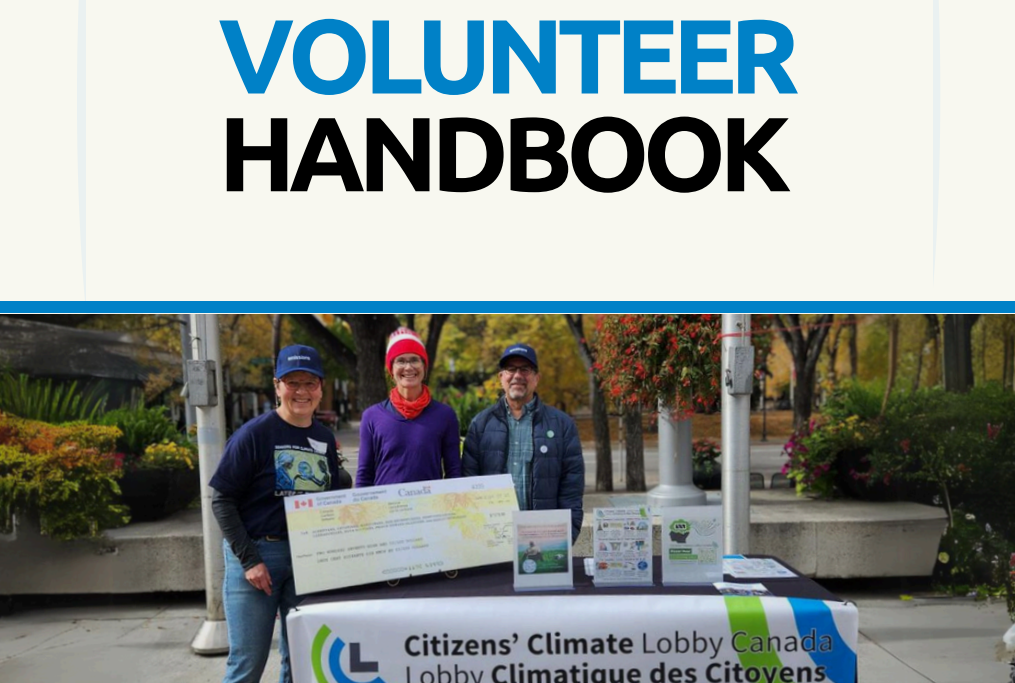 |
Volunteer Handbook CCL Canada (version June 2025 – update coming soon | |
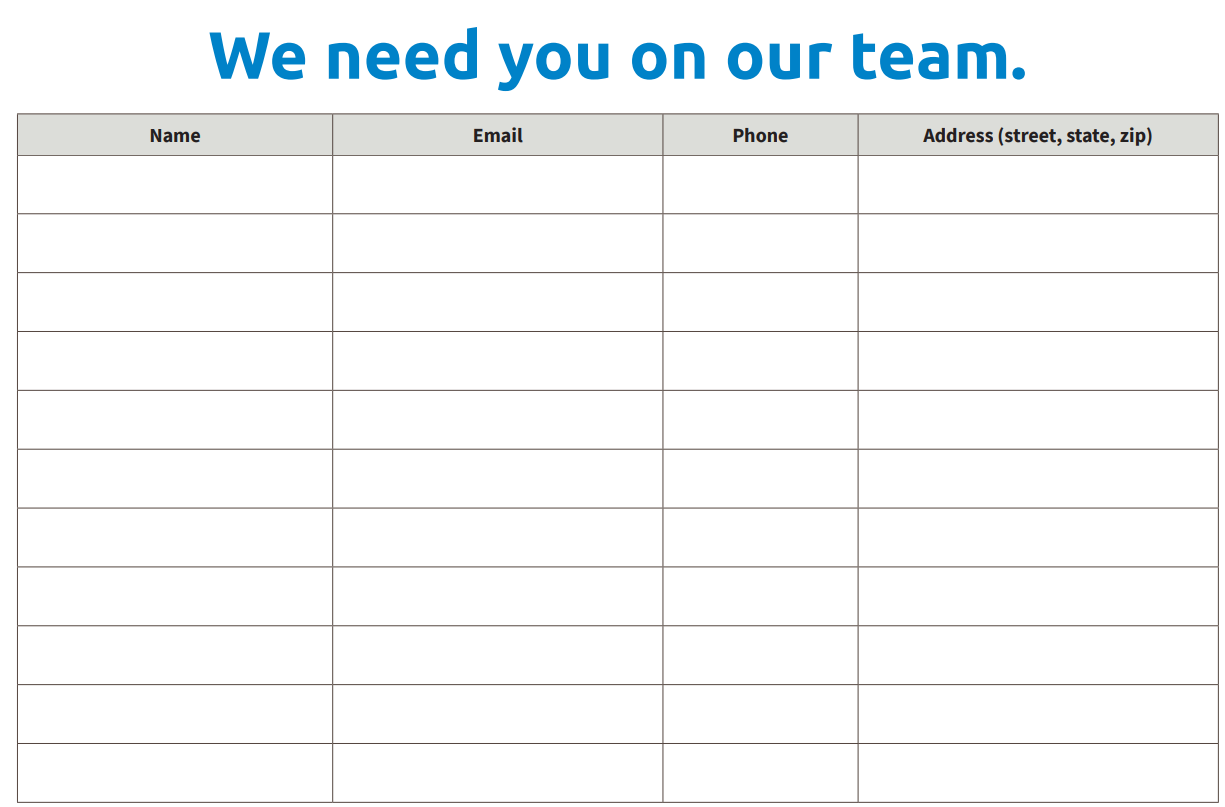 |
CCL Canada’s signupsheet | February 2026 |
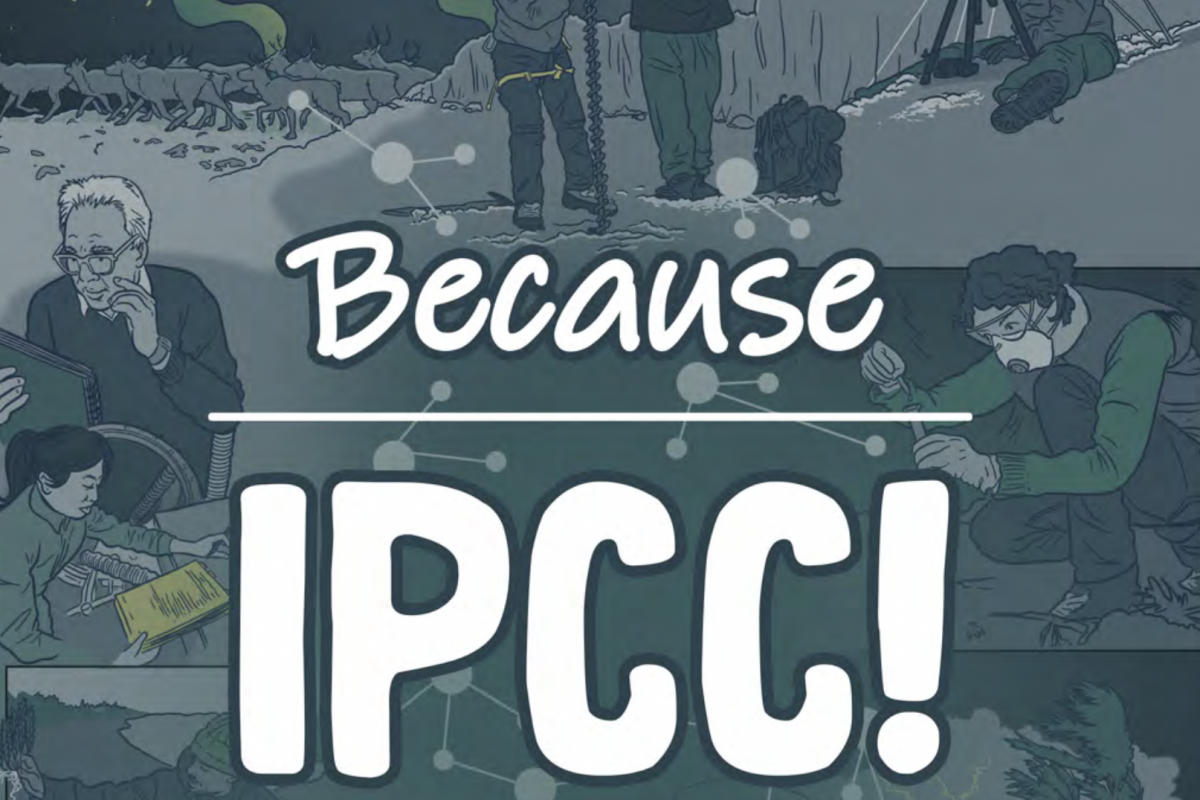 |
The graphic novel: Because IPCC: Download the book, for free. Check out our Laser Talk about Because IPCC to find out more and how you can download free copies and graphics for your outreach. |
February 2022 Still very relevant |
 |
Customizable CCL business cards 3.5x2in.Colour: PDF, PNG or JPG Black/white: PDF, PNG or JPG Greyscale: PDF, PNG or JPGDon’t forget to put your own contact information on the back, e.g. black/white or colour |
Talk Like a Human
Welcome to Citizens’ Climate Lobby Canada! We empower each other to become effective messangers of evidence-based climate policies using a proven theory of change.
- Past Calls and Monthly Actions – Since September 2010, we have been meeting monthly to educate and empower each other.
- Laser Talks – Check out our short overviews of a number of topics relevant creating the political will for a liveable world.
- Volunteer Handbook CCL Canada (version June 2025) – get to know how we work and all the ways you can get involved.
Really important climate communications tools
- Talk-Like-a-Human from Potential Energy provides guidance for climate advocates on communicating effectively by using relatable, human-centric language to connect with their audience and drive climate action.
- Unnatural Disasters: Connecting the dots when communicating about extreme weather and climate change from Potential Energy
- ReClimate Public Opinion Survey on carbon pricing
- Re.Climate-Tips-Heat-Waves-Disasters-2024 gives Canadians evidence based talking points on how best to talk about the unnatural disasters fueled by fossil fuel pollution
CCL Canada Banners and Logos
- Square CCL Canada transparent (png)
- Square CCL Canada white background (png)
- Rectangular CCL Canada banner transparent (png)
- Rectangular CCL Canada banner with stripes white background (png)
- Rectangular CCL Canada banner with words (png)
- Rectangular banner words and website (pdf)
- CCL Canada Black and White Banner with white background
Parliamentary Petition Project
PURPOSE: We use paper parliamentary petitions to educate parliamentarians and our local communities about the urgency of the climate crisis and solutions to improve the Greenhouse Gas Pollution Pricing Act as well as other policies that redirect financial flows, amd cap emissions.
CCL Canada petitions:
- Climate Aligned Finance Act Parliamentary Petition
- Coming soon one for the Industrial Carbon price
CCL Canada is also supporting the KAIROS Jubilee petition for debt justice:
- Turn Debt Into Hope Paper Parliamentary Petition
- Instructions Turn Debt Into Hope Parliamentary Paper Petition
Government resources:
The Path of Paper Petition
Paper Petitions – Guide and Terms of Use
For Further Information
Clerk of Petitions
Room 314-C, West Block
House of Commons
Tel: 613-992-9511
Fax: 613-947-7626
Email PMB-AED@parl.gc.ca
Instructions:
- Have people sign the petition at outreach events and/or carry a copy of it and ask friends and acquaintances to sign it.
- Once you have obtained 30 signatures, call your MP’s office
- Identify yourself as a constituent of his/her riding
- Ask if your MP if he/she would be willing to read our Parliamentary Petition on climate change in its entirety (excluding the signatories) in the House of Commons
- Print the petition on legal (8.5 x 14) or letter-size (8.5 x 11) paper.
- Make sure there are three lines for signatures on the first page.
- Make sure there is a line at the top of every signature page thereafter indicating that it is a parliamentary petition and its topic.
- Get at least 25 signatures on the petition – follow the instructions closely. We recommend getting 30 just to be safe.
- Once completed, copy it for your files if you wish, then bring the original file to your MP’s office to be read in Parliament.
Hand-deliver or send the original copy of the petition to:
YOUR MP’S NAME
House of Commons
Ottawa, Ontario
K1A 0A6
No stamp is required for Parliament in Ottawa.
If your MP does not want to read the petition, you can send it to other MPs who will. Follow up by asking when it will be read in Parliament, how it was received and a big thank you via snail mail, email, and social media. Please inform us in your monthly Citizens’ Climate Lobby field report if your petition has been read aloud in the House of Commons. It is considered to be outreach. By informing the national office we can thank them on Twitter and Facebook.
Cabinet Ministers are not permitted to read petitions in the House of Commons as it would constitute a “conflict of interest”. Thus if your MP is a cabinet Minister you should inform him/her about the petition and ask if he or she could suggest another MP from your province who might read the petition instead.
WE DID IT!
Please note this 2020 petition 2020 to the Government of Canada to Improve the Greenhouse Gas Pollution Pricing Act was implemented.
CCLC Petition September 2020 ENGLISH (PDF)
CCLC Petition Septembre 2020 FRANCAIS (PDF)
PARLIAMENTARY E-PETITIONS
These are the official e-petitions that are read in the House of Commons.
Online parliamentary petitions and any online petition are a lot of work. Here are the steps to go through to get one considered by our network.
- First, there must be buy-in from most of the CCL group leaders – especially from the Parliamentary Petition Team – the team that knows the intricate steps.
- Then we need to form an eager National Action Team with clear job descriptions, and a step-by-step plan to attain 1000+++ signees. This is a multi-step process.
- Join CCL Canada monthly calls if you ever have the idea to do an online Parliamentarian Petition and talk it over with your national colleagues. We row together. No one person makes decisions for national actions.
We have successfully conducted three parliamentary e-petitions campaigns.
PARLIAMENTARY E-PETITION MARCH 22 2024 – CLOSED APRIL 21, 2024. In late March 2024, it came to our attention that someone had launched e-petition (#e2876 )in support of carbon pricing with MP Rachel Blaney. This person was not known to us but their petition was not gaining traction. So we determined we would support it and in one month we helped get 1492 signatueres on the petition. For comparison, a basic income e-petition launched January 29, 2024 and closed April 28, 2024 received 648 signatures. We organically grew our social media feeds by magnitudes during this campaign but it was a lot of work and unexpected too and we won’t do it again without a plan and considerations of our workflow.
PARLIAMENTARY E-PETITION APRIL 2020 – CLOSED AUGUST 18, 2020 On April 2020, 2020 CCL Canada launched an e-petition (#e2542) for improvements in the Greenhouse Gas Pollution Pricing Act. Nickel Belt MP Marc Serre (Liberal) sponsored the petition. It received 1249 signatures.
PARLIAMENTARY E-PETITION MAY 2016 – Closed On May 11, 2016, CCL Canada launched an e-petition (#e297) for carbon fee and dividend. Beaches-East York MP Nathaniel Erskine Smith (Liberal) sponsored the petition. It received 898 signatures.
Lobbying Tool Kit
Lobbying Resources
- Getting ready to lobby document (exemplar)
The lead person makes sure there is a biography of the parliamentarian in a document. Lobbyists meet before the lobbying session to review the document, assign roles in the meeting, the focus of their lobbying based on the most current “leave behind” and design possible motivational interviewing questions. - Lobbying Training Slides
- Script for securing an appointment
- Our Winter bilingual lobbying document a.k.a. the Leave Behind.
LASER TALKS FROM OCTOBER 2025 – NEED SOME UPDATING BUT PRETTY CLOSE – Check back in May for more complete resources
Maintain and strengthen industrial carbon pricing, with a steadily increasing national carbon price and increasing stringency in its application.
- Importance of industrial carbon pricing and why it needs improvement
- Models Show the Power of Canada’s Carbon Pricing Policies
- Carbon Pricing Around the World (September 2025)
- B.C. Debt and Deficit Balloon with Carbon Tax Gone
- Low-Income Households Pay the Price for Carbon Policy Change
- The Constitutionality of Carbon Taxes vs Caps on Emissions
- Climate Leaders Cut Pollution
Fully implement the Canadian climate finance taxonomy framework and introduce a federal framework for a climate-aligned financial system in alignment with the 1.5C goal and the best practices cited above.
- Canadian Banks are at a Climate Crossroads
- Canada’s Sustainability Standards Board (CSSB) Rules
- Canada’s need for a Climate Taxonomy
- ENVI COMMITTEE REPORT https://www.ourcommons.ca/Content/Committee/451/ENVI/Reports/RP13856138/envirp02/envirp02-e.pdf
Common Messaging for all them
- Best Practices for Developing Regulatory Frameworks
- The Big Switch Will Save Us Money
- What about China
- Renewable Energy and Storage are Unstoppable
- The Global Electrotech Revolution
- Canada’s 2024 GHG Emissions Have Flatlined
- CCS: A Not So Grand Bargain
- Our Stance on Nuclear Energy
- What About Jobs?
- Healthy, Wealthy and Wise
- Canada Needs Tax Reform
- The Power of Optimism and Effective Messaging
Check out the House of Commons Calendar to know when your MP will be in your riding to lobby.
We also recommend you bring any published media your group has generated and a list of signatories from your community to our Open Letter. If you are new to CCL you can bring our most recent editorial packet
All Things Media
Op Eds
Letters to the editors
- Links to many Canadian LTE submission pages (updated March 2018)
- CCL USA’s Letter to Editor Resources Page
- Tips for getting Letters to the Editor (LTEs) published and how to get the most out of them (updated January 2017)
- RESULTS resource for linking to many papers across Canada
- Power Point Presentation on writing LTEs
- Examples of Lobbying Stories by CCL Canadians
- Sample LTEs
- Create a writing team
Meeting with editorial boards
- Meeting with editorial boards
- CCL USA’s meeting with editorial boards page
- Recent CCL Published Media (all of CCL internationally)
Media Releases
- Tips for writing media releases for local CCL events and an example
- CCL Canada Media Releases
How we plan our national actions
National Action Planning Policy
1. Role of Volunteers
Volunteers are CCL Canada’s most valued resource. Volunteer input informs nearly all national actions. The national office is committed to respecting volunteer time by offering actions that are strategic, achievable, and aligned with CCL’s mission to build political will for a liveable world.
2. Scope of National Office Responsibility
The national office does not direct, facilitate, or coordinate provincial, territorial, or other subnational actions. This reflects limited national capacity and the diverse political and organizational contexts across Canada.
3. Advance Planning
National actions are planned several months in advance. Planning is informed by volunteer reports, organizational priorities, and relevant provincial, national, and international developments.
4. Process for Proposing National Actions
4.1 Local Review
Proposed actions must first be discussed within the local team to assess interest and feasibility.
4.2 Submission to National Office
Proposals must be shared with the national office by emailing canada@citizensclimateclimate.org or by contacting the National Director. Proposals must include:
- Supporting research
- Proposed timelines
- Defined roles and responsibilities
Proposals must demonstrate alignment with CCL Canada’s strategic goals, including efforts to reduce financial support for fossil fuels.
4.3 Feasibility and Capacity Assessment
Where sufficient capacity and commitment exist, proposals may be shared with the membership to assess interest. A national action team may be established to define timelines, roles, communications, and responsibilities for inclusion in action sheets.
4.4 Scheduling and Implementation
Approved actions are scheduled at a time that best aligns with subnational, national, and international developments.
5. Coordination Requirement
Actions requiring national office support or resources must not be initiated without prior approval from the national office.
5. Lobbying
We are focused in 2026 on two federal policies: industrial carbon pricing and climate-aligned finance.
CCL’s one and only rule is respect and admiration for service. Thanks for considering everyone’s service and workflow.
The Five Levers of Political Will
Our Five Levers of Political Will
These are the five core activities that all Citizens’ Climate Lobby chapters leverage to bring citizens into the political process and to ensure their contribution is constructive and makes more good possible. We call these activities the “levers of political will.”
- Lobbying: We train citizens how to lobby in support of policies that redirect finances away from fossil fuels by building friendly relationships with our federally elected representatives.

- Media relations: We train citizens how to engage with and influence the media. We write letters to the editors and op-eds, meet with editorial boards and work to place stories in all forms of media.
- Grassroots outreach: We recruit and educate the public on climate solutions, citizen advocacy and how to participate with one’s government.
- Grasstops outreach: We seek to educate, build partnerships with and gain the support of community leaders and non-governmental organizations, both nationally and locally.
- Chapter development: It is through the growth and management of the local CCL group/chapter, that it becomes possible to push on the other four levers for building political will.

Note we are not “against” anything: we are for carbon fee and dividend. Carbon pricing policies in Canada will be assessed using the following criteria available in English and in French.
Posters and Cartoons
Some of these may be dated for now but they might become relevant again. Enjoy!
Posters and infographics
-
- Carbon rebate cheque
- Everything is connected” poster PDF (English) and French
- Poster: Progressive Policies Reward Carbon-Friendly Consumer Habits
- Poster: The Five Chief Ways to Price Carbon (full-length, 28x28in or abbreviated, 21×37.5in)
- Poster: Citizen Climate Lobbyists create political will by…
- Poster: Why Carbon Fee and Dividend?
- The Five Ways to Price carbon – a great visual for orienting politicians unfamiliar with carbon pricing to the various solutions
- Carbon Fee and Dividend cartoon also available in French
- Ressources en Français
CAFA Postcards
Summer 2026 CAFA Post Cards
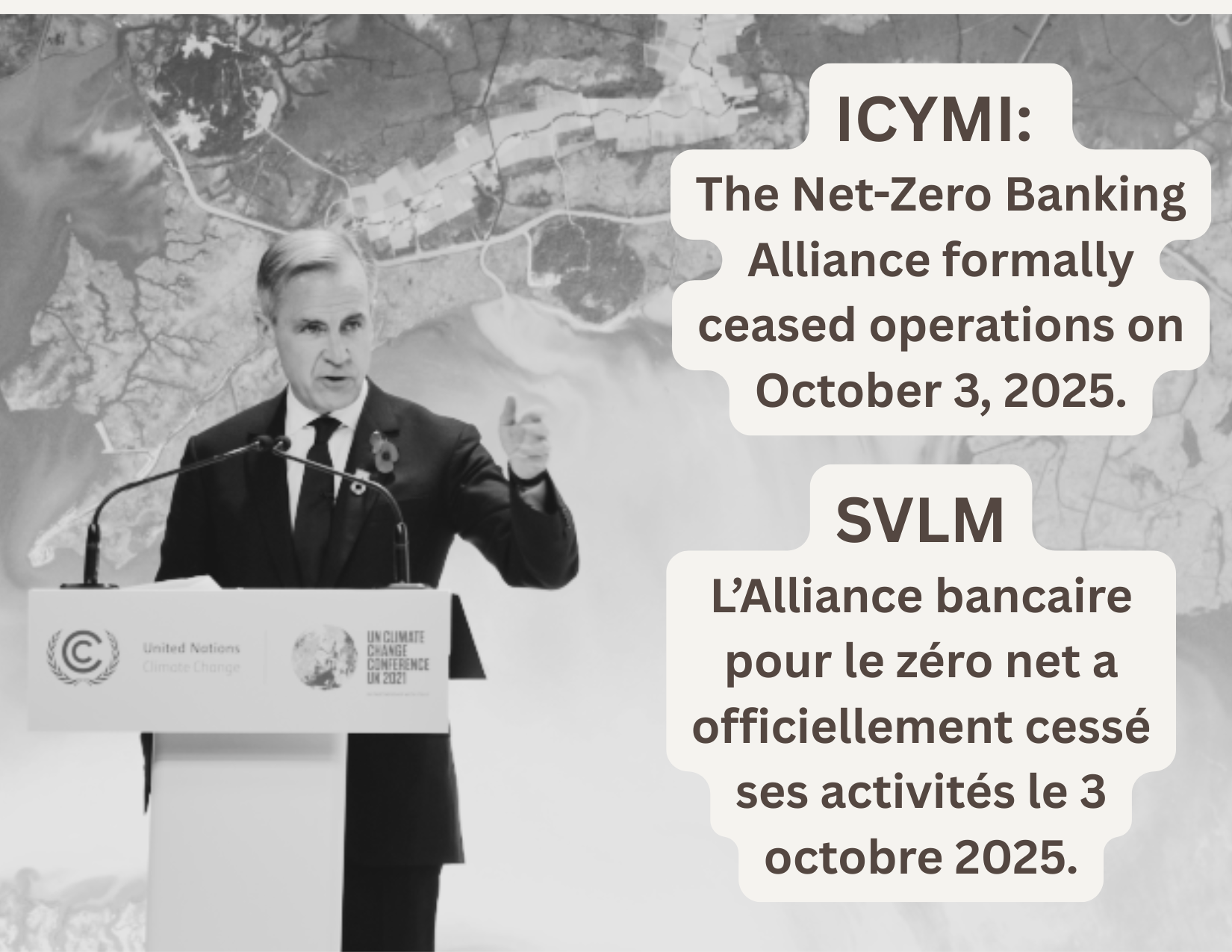
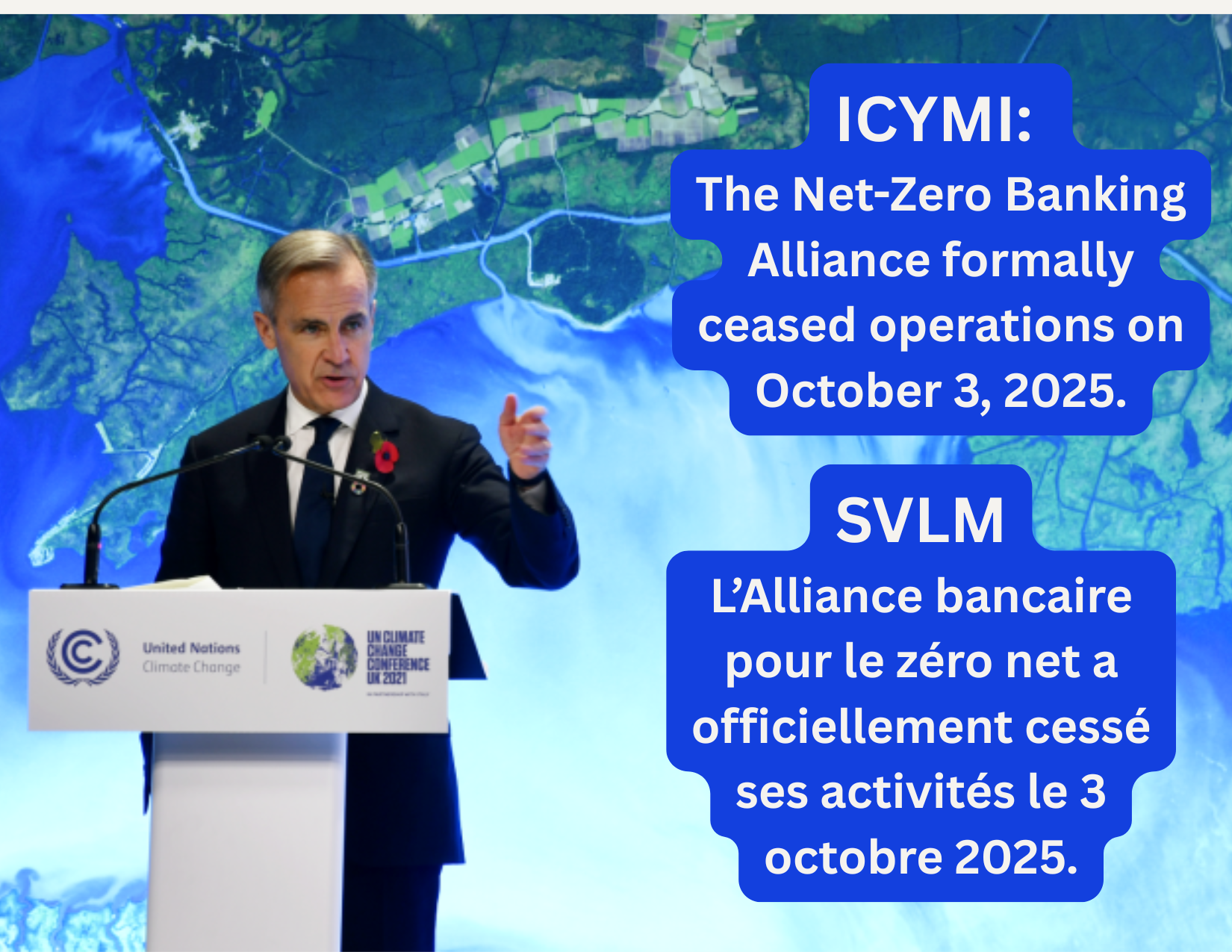
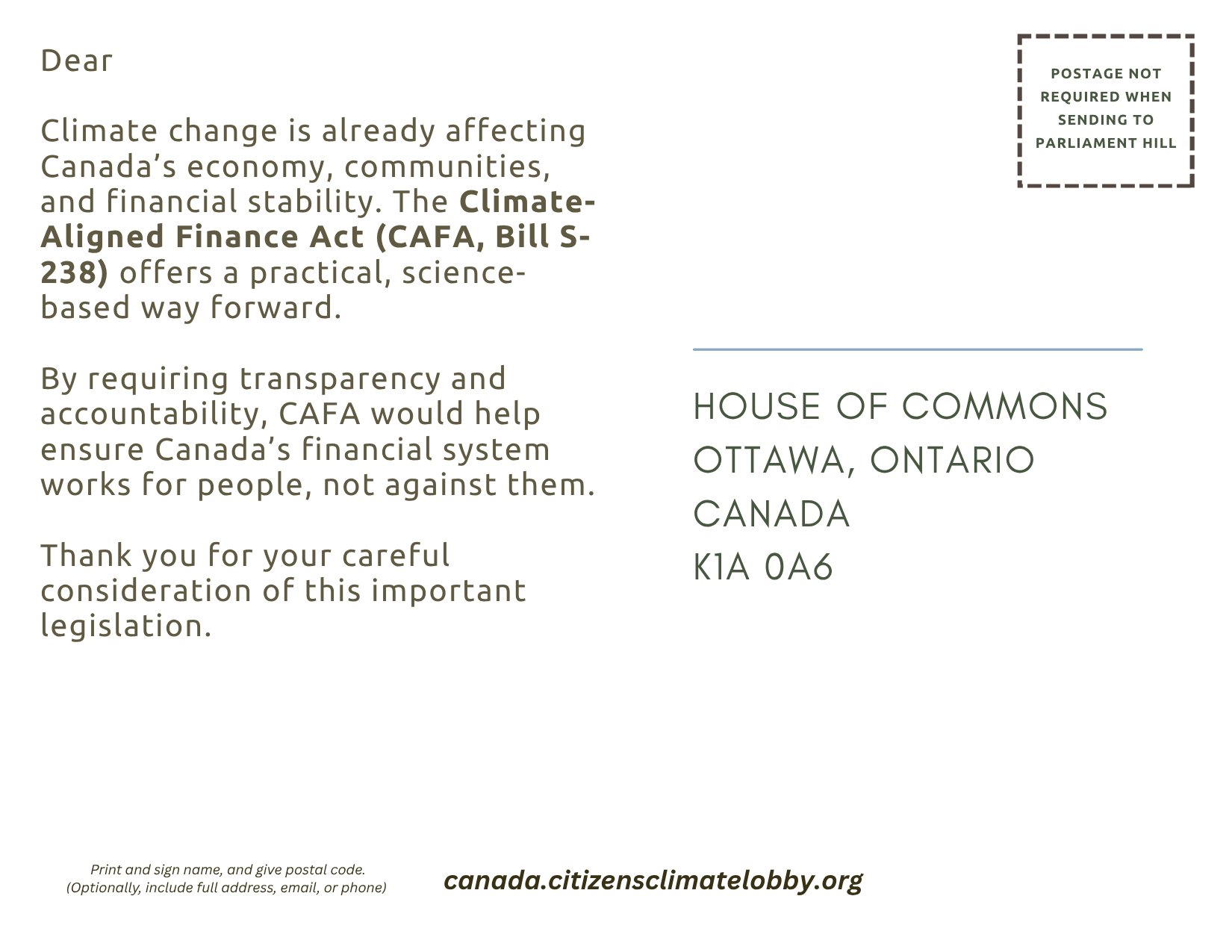
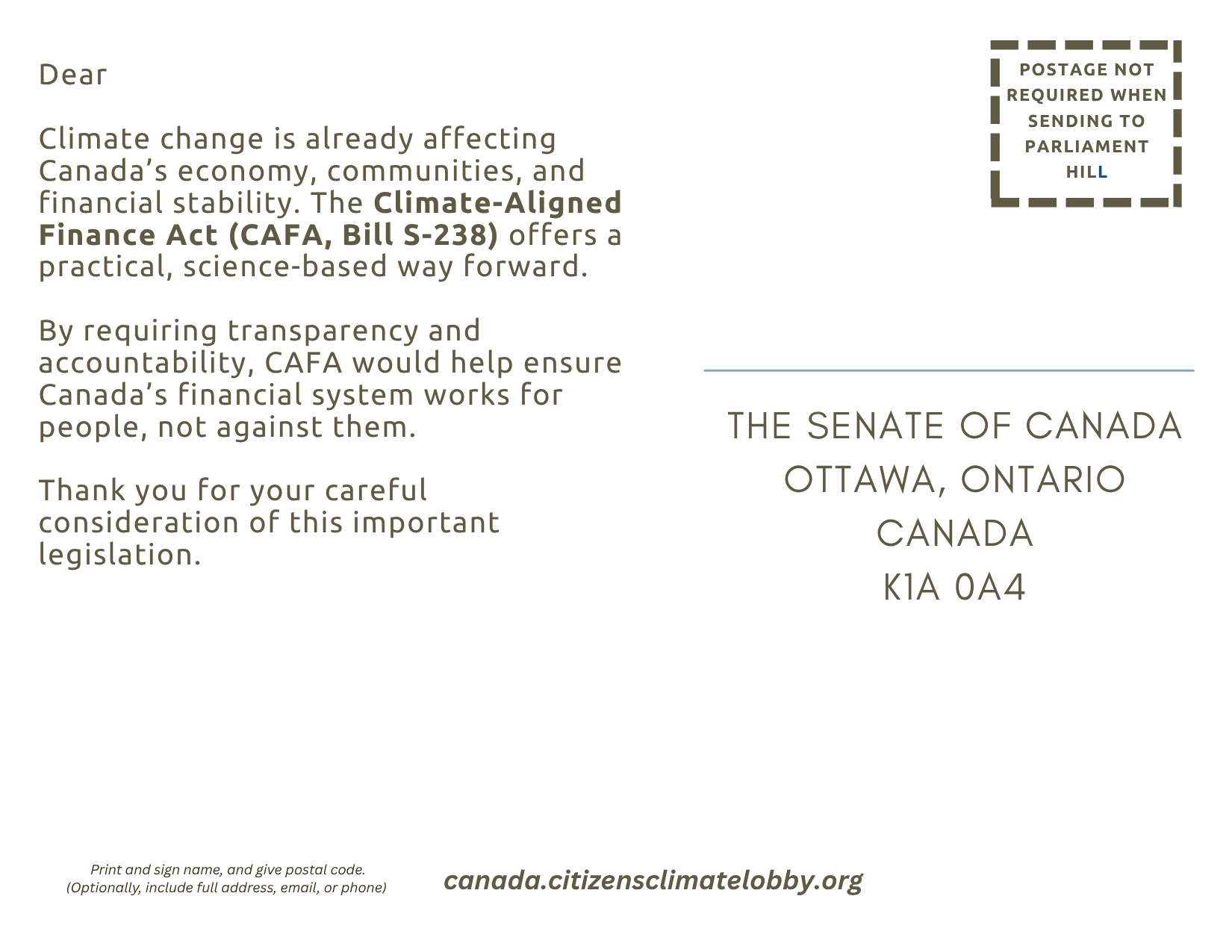
n.b. The backs of the postcards are specific for Senators or MPs
and no postage is required to send cards to Parliament Hill.
Previous Postcards
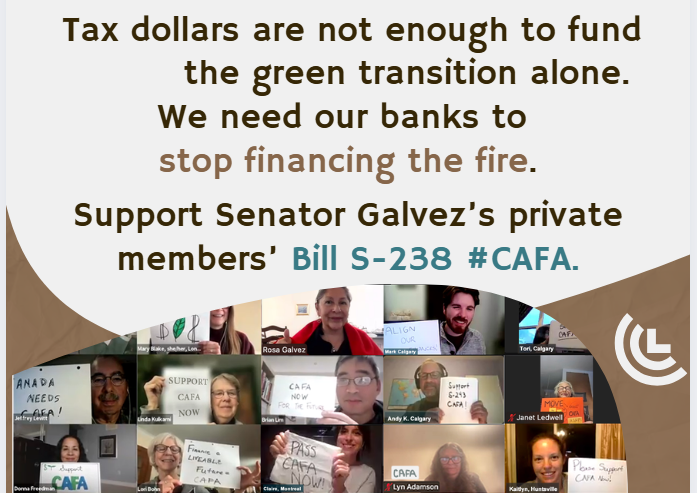
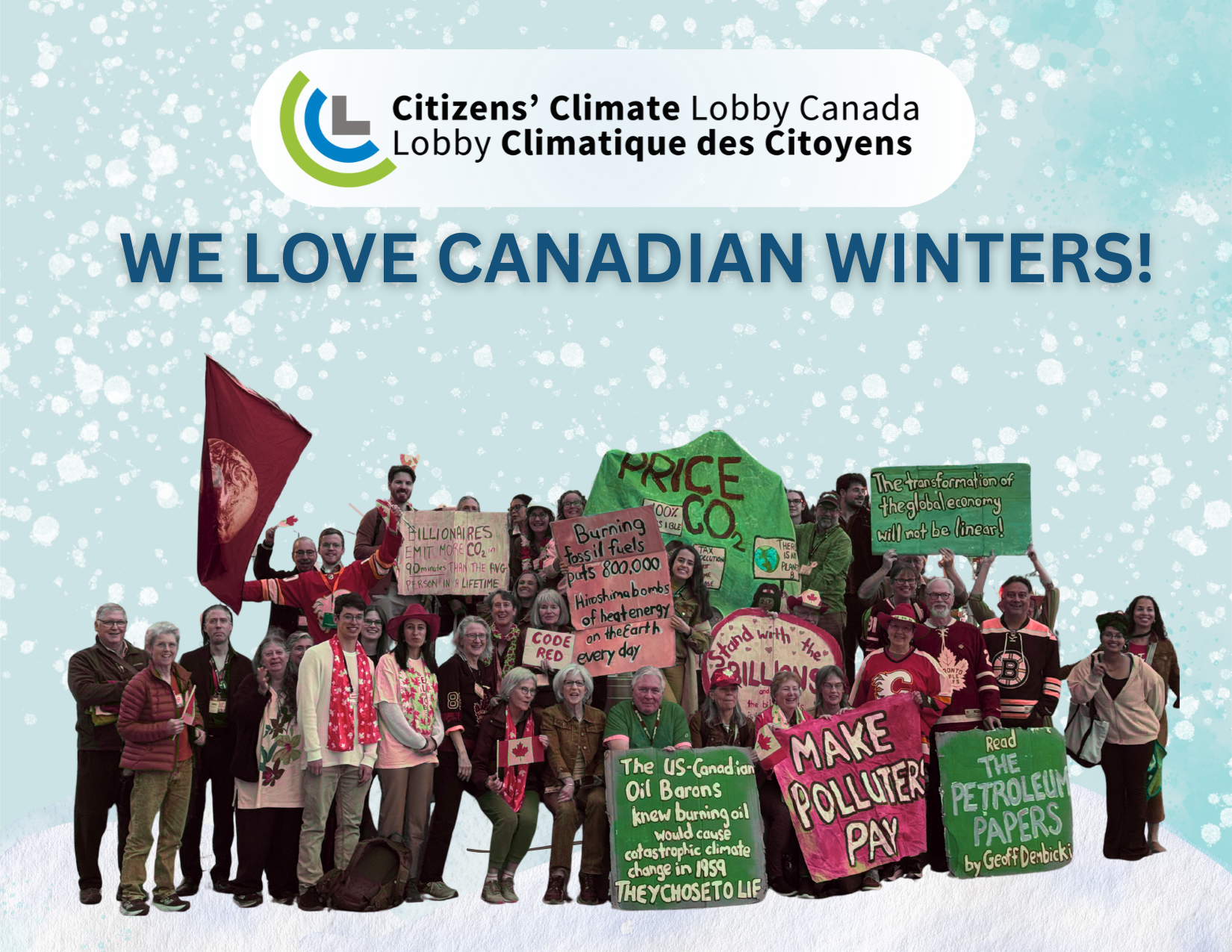
For Valentines Day 2026 we created postcards to support the Climate Aligned Finance Act. We have changed the back of the card so that you can use them year round.
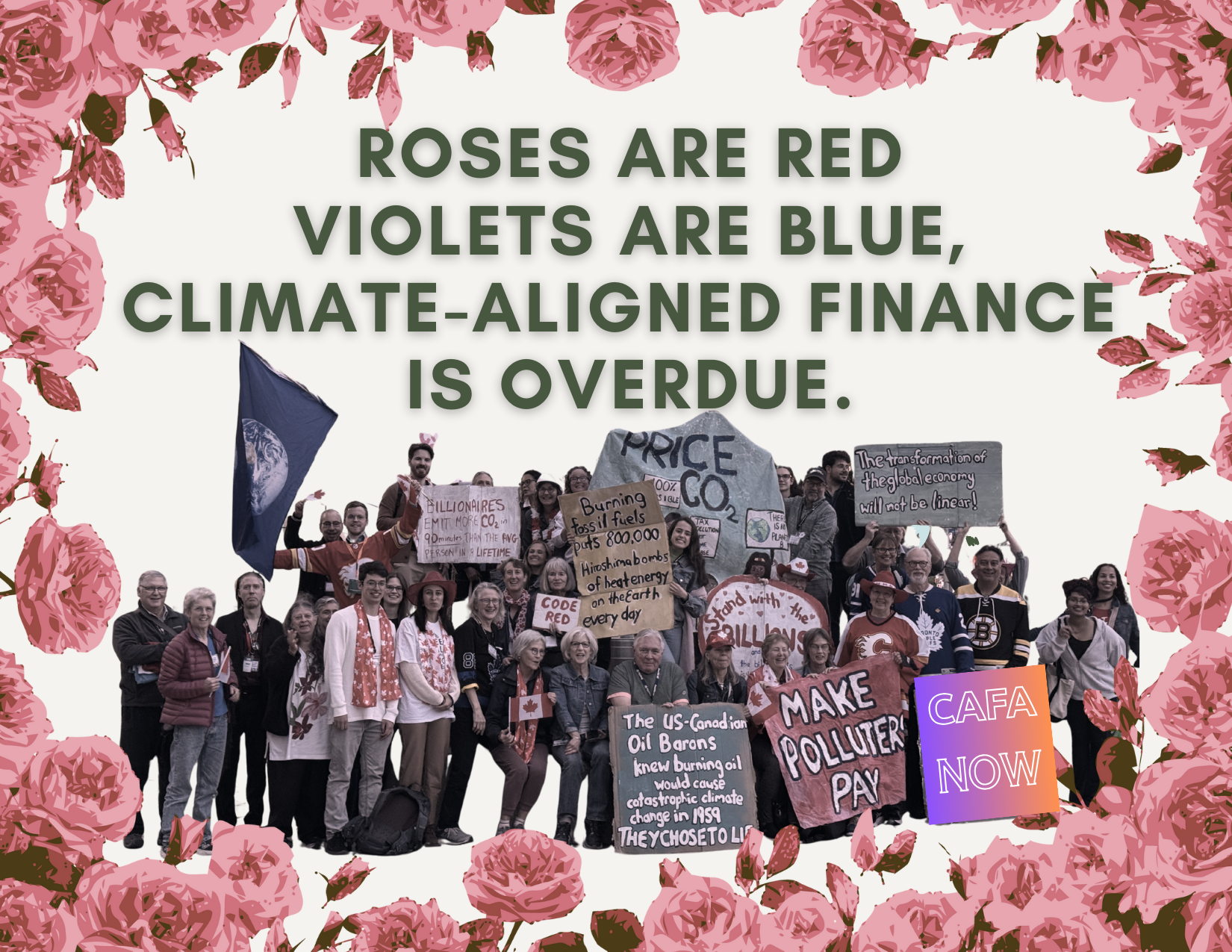
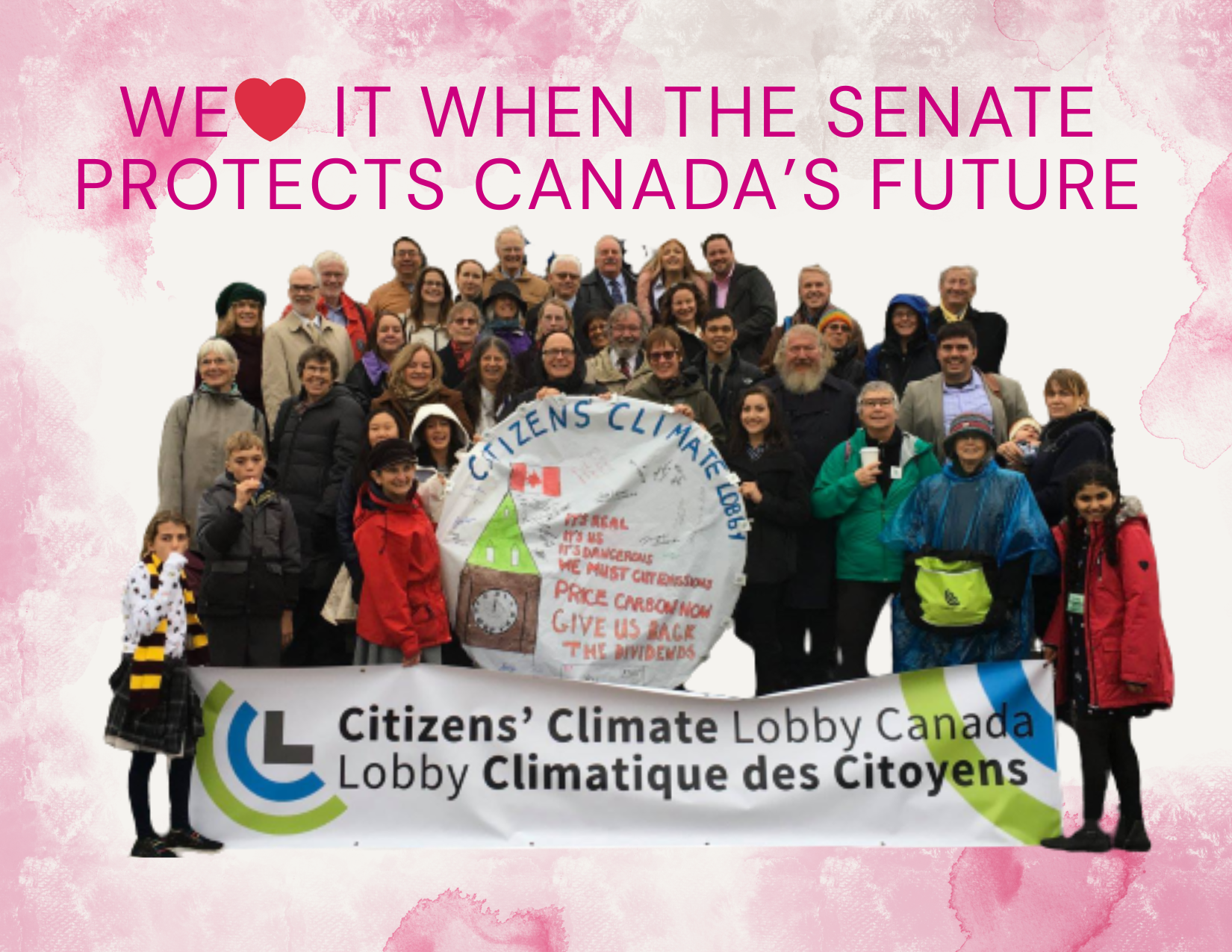
Note the back of the cards do not reference Valentine’s Day.
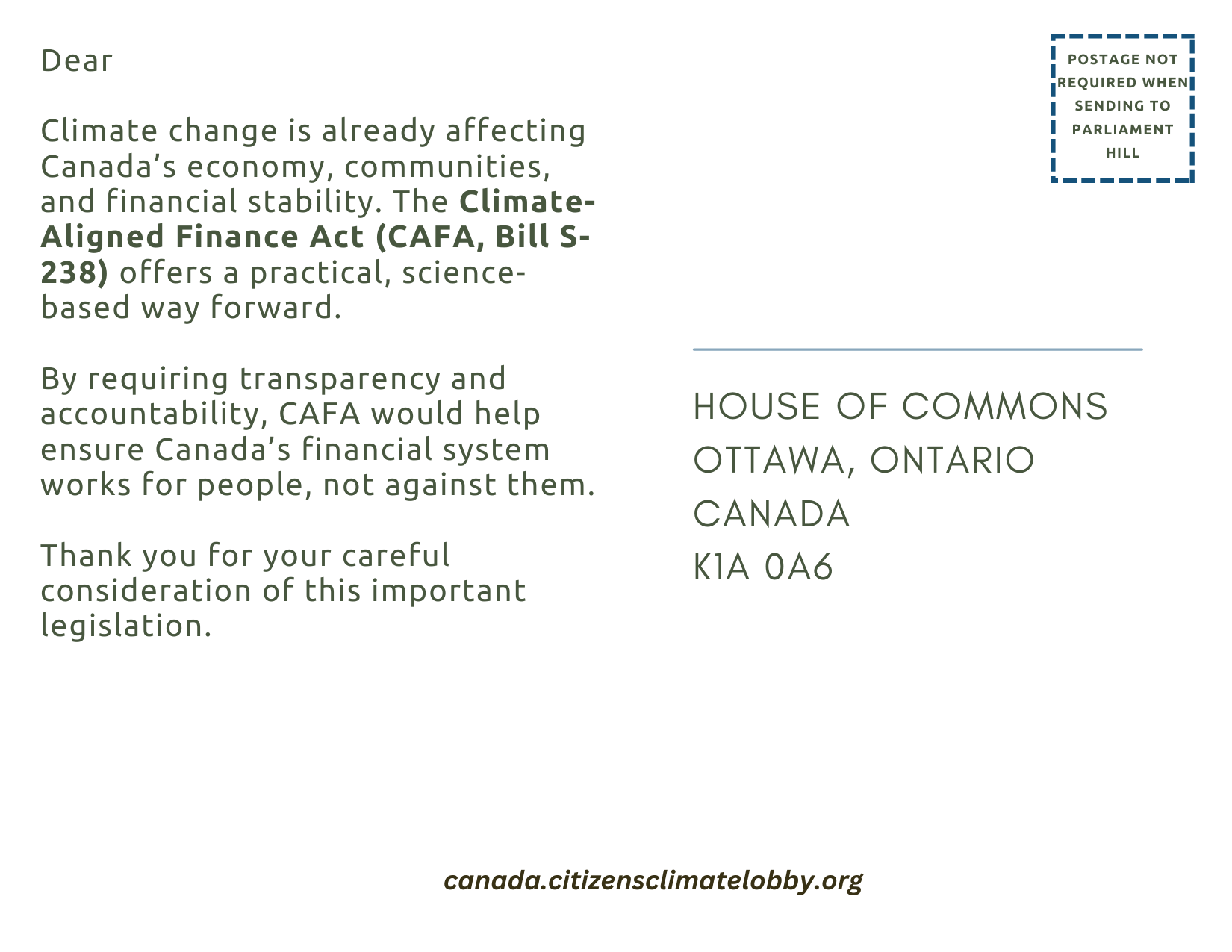
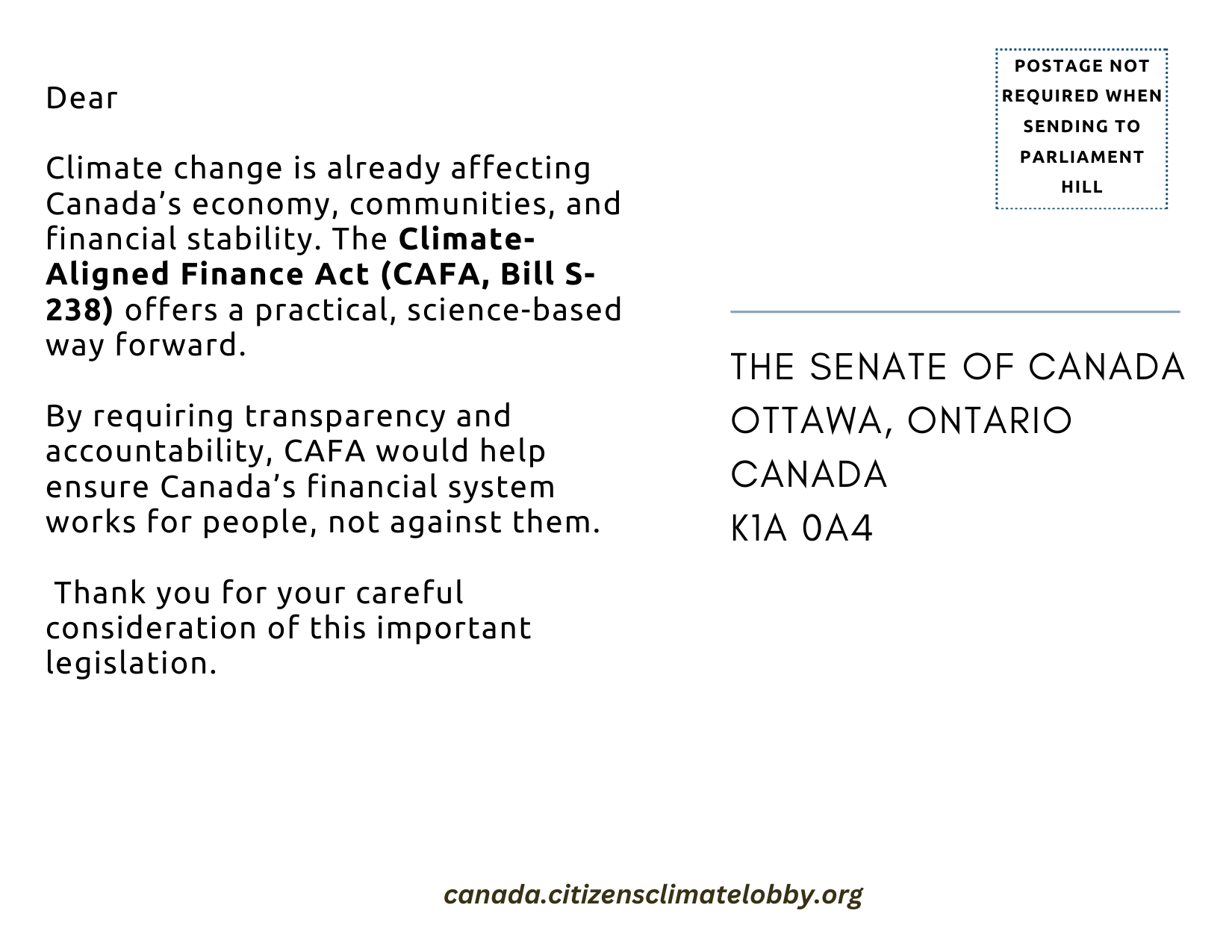
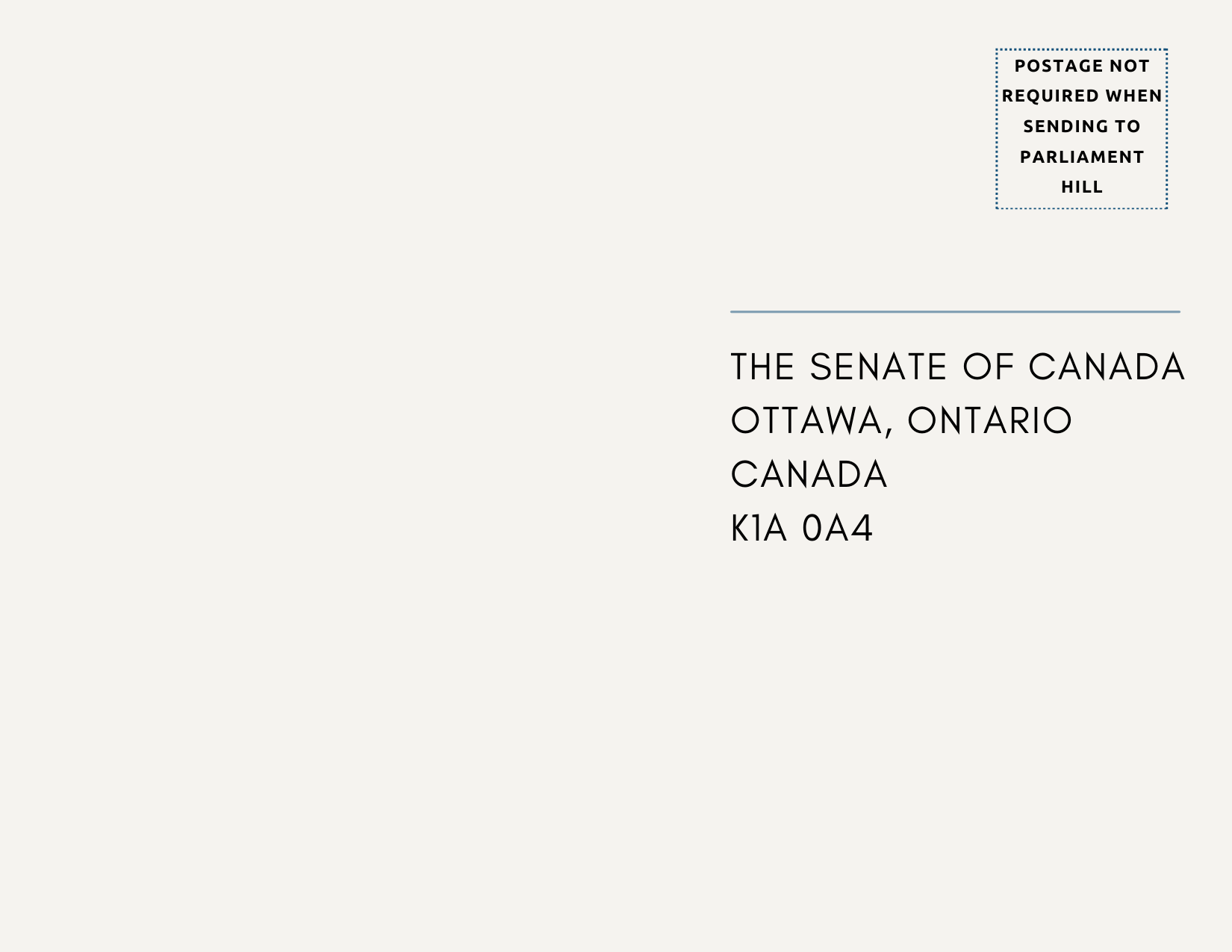
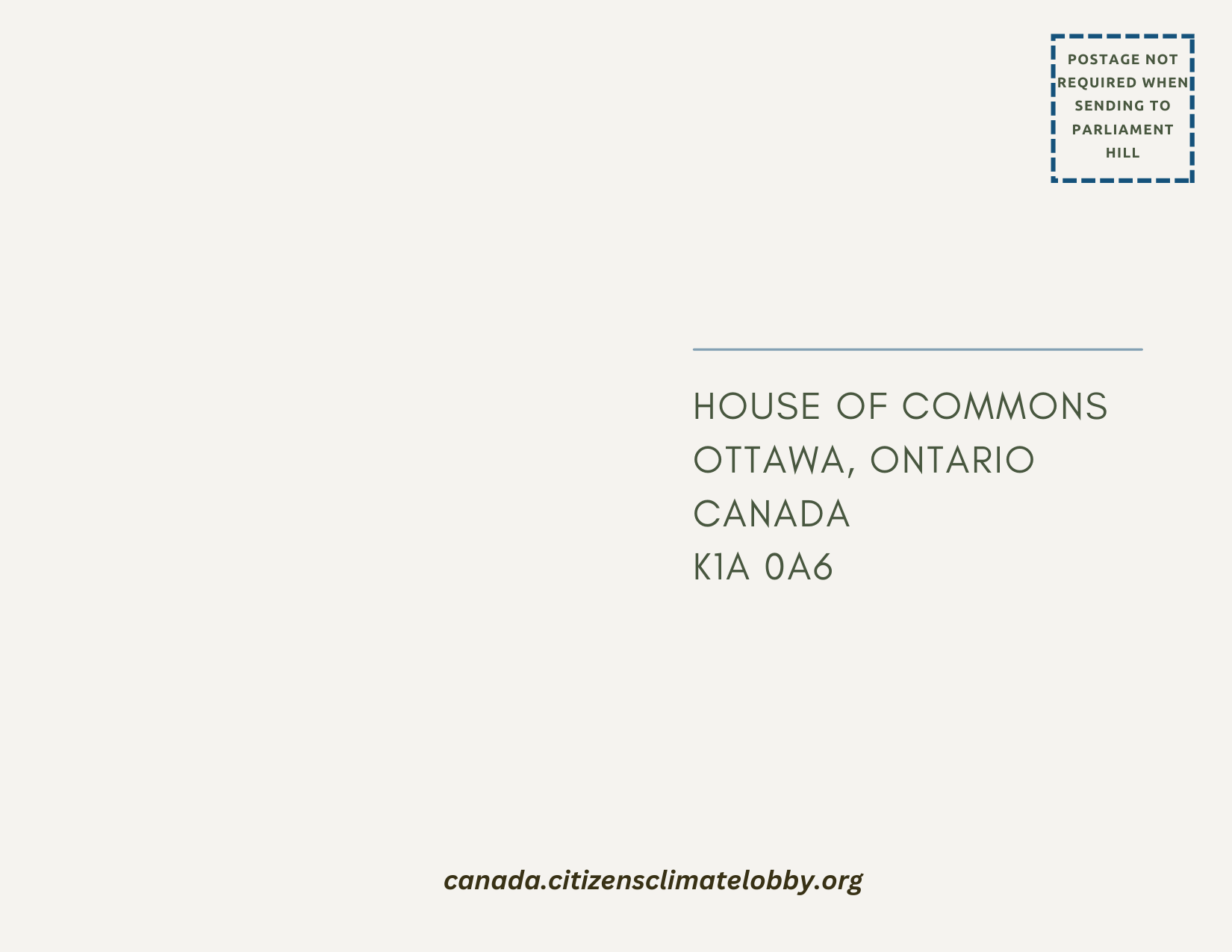
Printing instructions:
- Right-click on an image and choose “Save image as” to download it to your computer.
Or edit the images directly in Canva by making a copy in your own account. - There are two postcard backs: one for the Senate and one for the House of Commons.
- To save on printing costs, the back of the postcard can be printed in black and white or greyscale.
- Choose your images, and print:
– on card stock for postcards, or
– on regular paper if you’ll use envelopes.
Signing the postcards:
- Be sure to put the name of the parliamentarian on the card in the two places as well as your name, city and postal code. (You can put your full address but there is not a lot of room).
- Note that postage is NOT required for letters and postcards sent to Parliament Hill.
Who to send the postcards to?
Focus on Senators in your city, region, and province as well as:
- Senate BANC Committees
- Senate Energy, Environment and Natural Resources Committee
- Senators for Climate Solutions
And two of the three cards are for all Parliament, so feel free to include MPs in your region, the Prime Minister, the Finance Minister, and MPs on these committees: