Simon Sharpe and Five Times Faster

Simon Sharpe: Five Times Faster


By popular demand here the slides: Simon Sharpe presentation for Citizens Climate Lobby 20260115


Simon Sharpe’s Five Times Faster Presentation

Why?
To reduce global greenhouse gas emissions to a safe level, humanity must decarbonize five times faster than we are today.

How can we do that?
Perhaps we should think differently about the problem—specifically, how we design policies to change outcomes.

A fault in economic theory
Most economic theories assume the economy is in equilibrium. In reality, economies are dynamic and constantly in flux. By leaning into this reality, we can accelerate the transition. Through case studies and a rethinking of economic paradigms, Simon Sharpe shows how we can transform the economy five times faster.

The starting point
We need to shift from prediction to risk assessment. When we do, it becomes clear that unchecked climate change imposes extraordinary risks on humanity due to feedback loops and tipping points such as the the weakening of the Atlantic Meridional Overturning Circulation, the ice–albedo feedback from melting ice, and permafrost thaw releasing greenhouse gases.. The good news is the economy has feedbacks and tipping points too. And therein lies the hope.

Feedbacks
Policy design should amplify positive feedbacks. For example, the cap-and-trade systems create dampening feedbacks and tend to underperform, while a carbon tax with rebates creates amplifying feedbacks and is far more effective.

Targeted subsidies
Early in an economic transition, targeted subsidies are essential. We must create the new before we dismantle the old or stated another way, build first, then break. Early resistance is high, but increasing demand lowers prices over time. Solar adoption in China and Pakistan is a clear example of this dynamic.

Regulations
Governments can enact regulations that force businesses to innovate in order to remain competitive. Necessity is the truly the mother of invention. Government regulations reallocate capital within firms, driving change. Zero-emission vehicle (ZEV) mandates are a strong example of how policy can accelerate the transition from gas-powered to electric vehicles.

Taxes
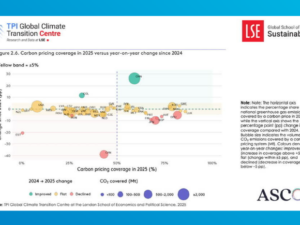
Simon begins by looking first at on the social cost of carbon, which are astronomically high because human extinction is a possibility,  and thus difficult to operationalize. There is no absolute value—prices are socially constructed. Instead, he reframes the issue around relative cost.

He shows how a fixed carbon tax removed coal from the electricity sector eight times faster than the global average in the United Kingdon. Norway provides another example: by combining EV subsidies with taxes on gasoline vehicles, EVs became cost-competitive at the point of purchase. In both cases, it was the price point of the new technology relative to the fossil fuel technology that accelerated the change. Crucially, taxation works best at the midpoint of the transition to be effective.

Taxes should also be sector-specific. In Canada, they are through industrial carbon price, as well as the cancelled consumer carbon rebate program  are also sector specific, which he explicitly.

Everything, together
R&D, public procurement, mandates, regulations, subsidies, taxes, and bans must all be used together and strategically leveraged over time. The sequence matters. Overall: build first, then break.

Diplomacy
In a static, equilibrium-based economy, burden-sharing emissions reductions is a negative-sum game.  Zero-sum game is a mathematical representation in game theory and economic theory of a situation that involves two competing entities, where the result is an advantage for one side and an equivalent loss for the other. Nobody wants to lose or pay the piper.

However, the real economy is dynamic, not static. When clean technologies enter the steep portion of the S-curve—where deployment accelerates, costs fall rapidly through learning and scale, and complementary systems mature—emissions reductions become a positive-sum outcome. Each additional adopter expands markets, lowers costs globally, and increases the returns to cooperation.

To focus on that S-curve, we must:

  • Act sector by sector
  • Build coalitions of the willing
  • Prioritize immediate action, recognizing that the future is uncertain and elections intervene

Under these conditions, diplomacy shifts from negotiating burden-sharing to coordinating acceleration. The strategic task is no longer how to divide costs, but how to move together quickly enough to capture shared economic, technological, and climate benefits.

By rethinking how the economy works and realistically leveraging pressure points, and cooperating we can accelerate the transition of the economy.


Simon Sharpe is Managing Director of S-Curve Economics and Director of Economics for the Climate Champions Team. He is leading expert in the economics and diplomacy of the low-carbon transition and among his many roles, Simon was Deputy Director of the UK government’s COP26 Unit,where he created global campaigns that led to significant international agreements on ending coal power, moving to zero emission vehicles, and protecting forests. 

With a background in policy, diplomacy, and climate risk assessment, Simon has led influential global projects and authored widely cited work on economic tipping points and climate action. His book, Five Times Faster: Rethinking the Science, Economics, and Diplomacy of Climate Change, was listed by the Times and Financial Times as one of the best environment books of the year 2023.

More Resources:
Here are Simon Sharpe’s Trottier Symposium Video and presentation.

Links to Announcements

February CCL Canada Educational Call
Leslie Shiell
From Rebate to Rate Cut: Low-Income Households Lose Out
Thursday, February 19, 2026
https://citizensclimate.zoom.us/meeting/register/-PJa667SQP2X8NOoKTbWaw#/registration

March CCL Canada Educational Call
Philip Newell
Climate Action Against Disinformation
Tuesday, March 10, 2026
https://citizensclimate.zoom.us/meeting/register/4lSZucZfRyqLFzvHnSteew

Weekly On Wednesday Nights Back to Back
Climate Leadership Launchpad
https://citizensclimate.zoom.us/meeting/register/1qwARUwwTJ-tBH7KIyrByw#/registration

Write to Ignite
https://citizensclimate.zoom.us/meeting/register/9bdP7KeCTEmMZw8PGSBIzA#/registration

Take Action
Sign onto our open letter for Climate Aligned Finance in Canada
https://docs.google.com/forms/d/e/1FAIpQLSefd49KtuoT2XrZ1mJYk6vzhp8I2RX9zZetGbFq8ojjsLYd6g/viewform