
Cool the Planet with Your Vote
How Your Vote in the 2025 Canadian Election Reduced GHGs:
New Research from Citizens’ Climate Lobby Canada
FOR IMMEDIATE RELEASE – March 18, 2026
Sudbury ON in Robinson-Huron Treaty Territory: On March 8, 2026, three federal by-elections were called in Canada, including the race in Terrebonne, Quebec where the Supreme Court of Canada had overturned the one-vote win. These by-elections underscore the razor-thin margins in Canada’s current Parliament: the Liberal government, led by Prime Minister Mark Carney, holds 170 seats, just two short of a majority after NDP MP Lori Idlout crossed the floor on March 10.
With the balance of power so delicate, every vote in these by-elections carry extraordinary weight, not just for parliamentary arithmetic, but for the future of Canada’s climate plans.
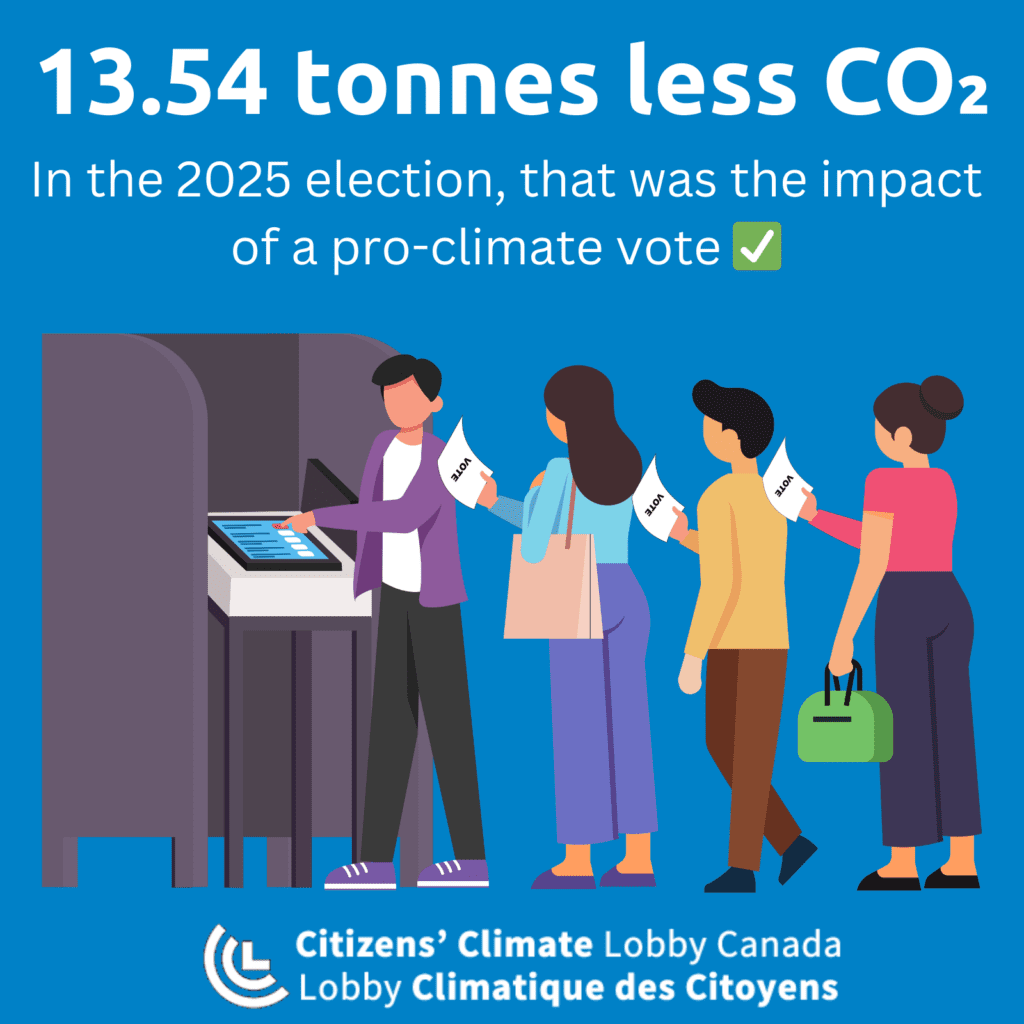
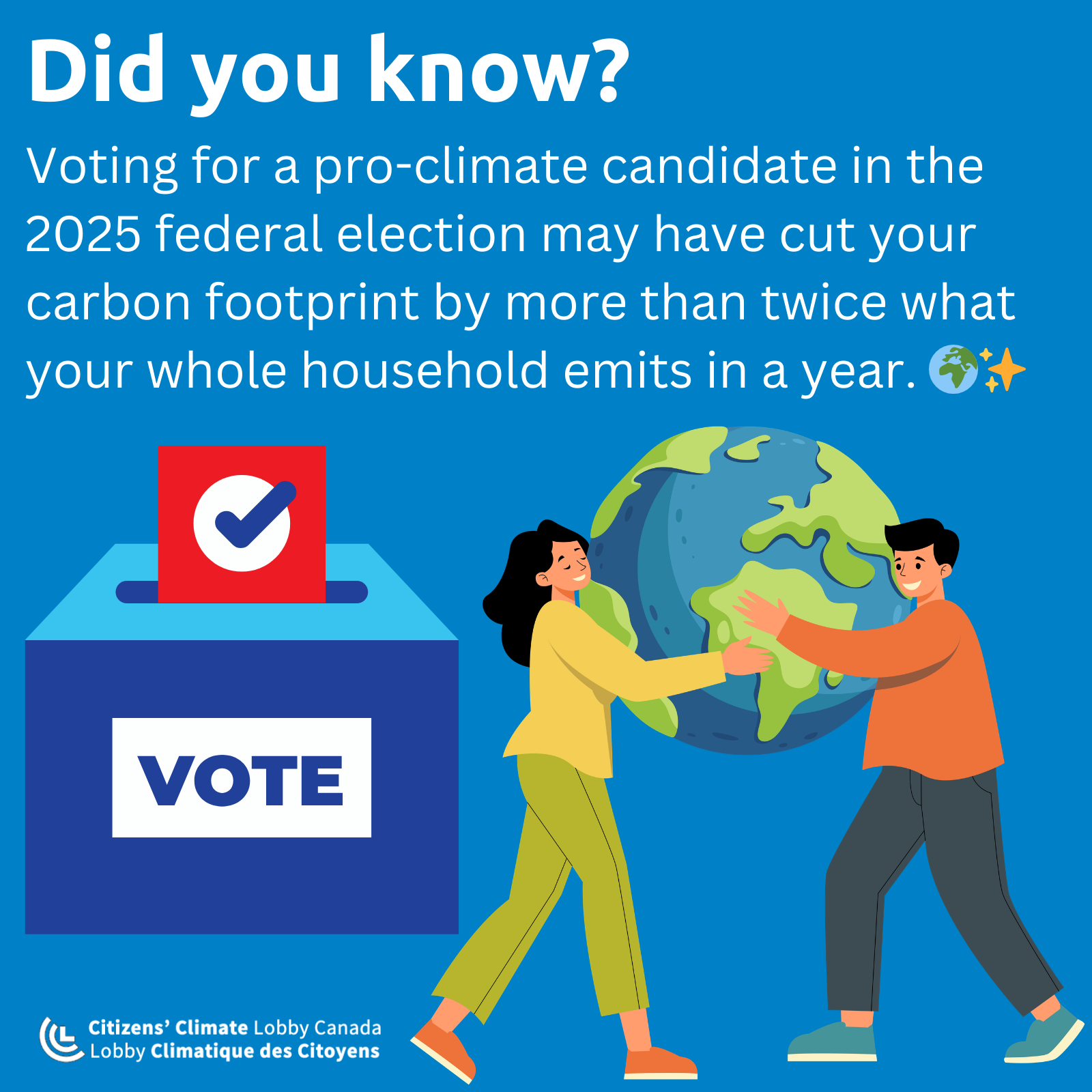
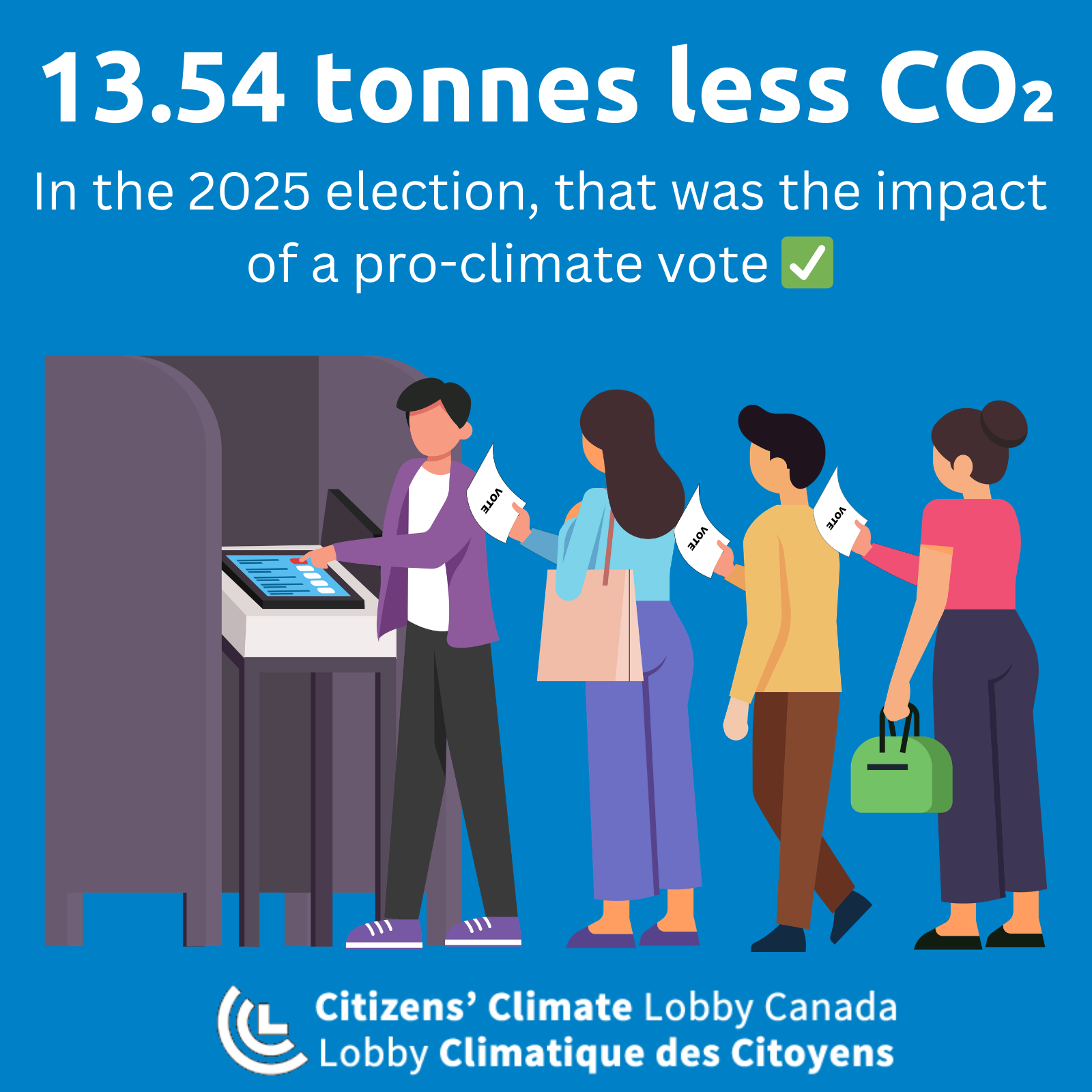
New research from Citizens’ Climate Lobby Canada (CCL Canada) reveals that Canadians who voted for pro-climate candidates in 2025, and whose candidate was elected, may have reduced their personal greenhouse gas (GHG) footprint by an average of 13.54 tonnes of CO₂ equivalent (t CO₂e) per year simply by helping elect a climate-friendly MP.
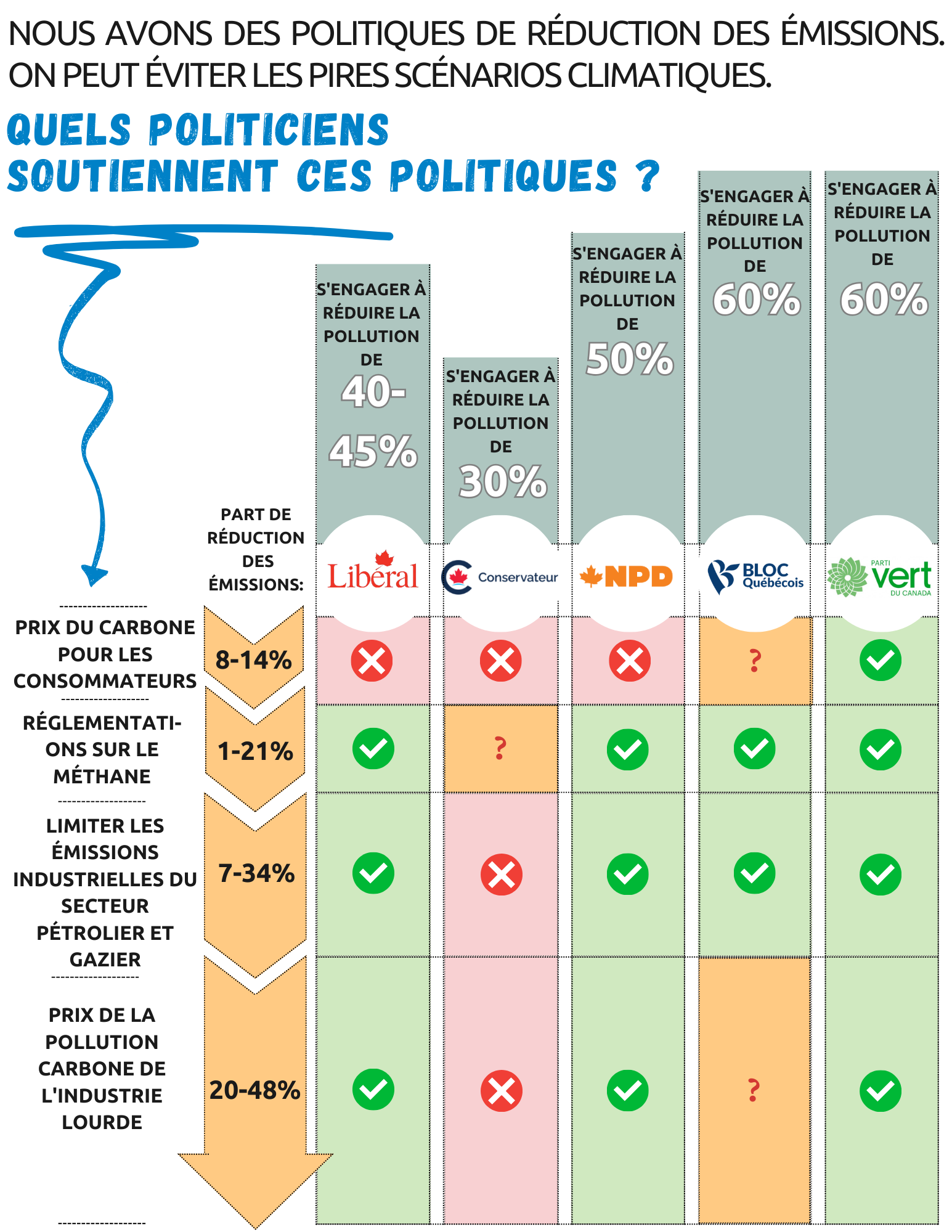
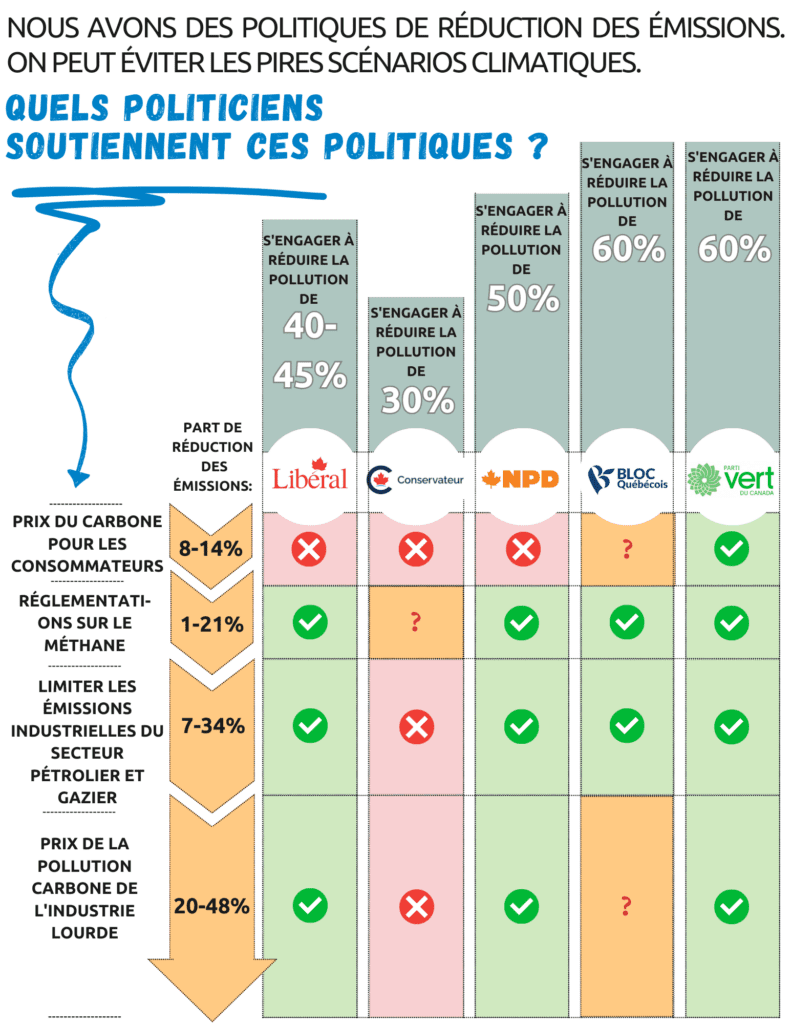
In 2025, Canada faced a defining choice. The Liberals, NDP, Bloc Quebecois and the Green Party campaigned on maintaining or expanding key climate policies, such as the industrial carbon price, and performance standards. The Conservative Party, however, would have dismantled the industrial carbon price, which costs about a Timbit per barrel of oil and replacing it with a focus on nuclear energy, hydroelectricity, and carbon capture—approaches that experts warn are insufficient to drive the deep emissions cuts needed in sectors like transportation and industry.
Drawing on analyses by Stark and Rhodes and published in Policy Options and Carbon Brief, it was estimated that a Conservative victory would have added 771 megatonnes (Mt) of CO2e to Canada’s emissions between 2025 and 2035. This calculation included the removal of the effective consumer carbon price with rebate. The result was primarily due to the rollback of industrial carbon pricing and performance standards. This figure formed the basis for CCL Canada’s calculation of the climate impact of individual votes.
To determine the emissions avoided per voter, CCL Canada used the following approach:
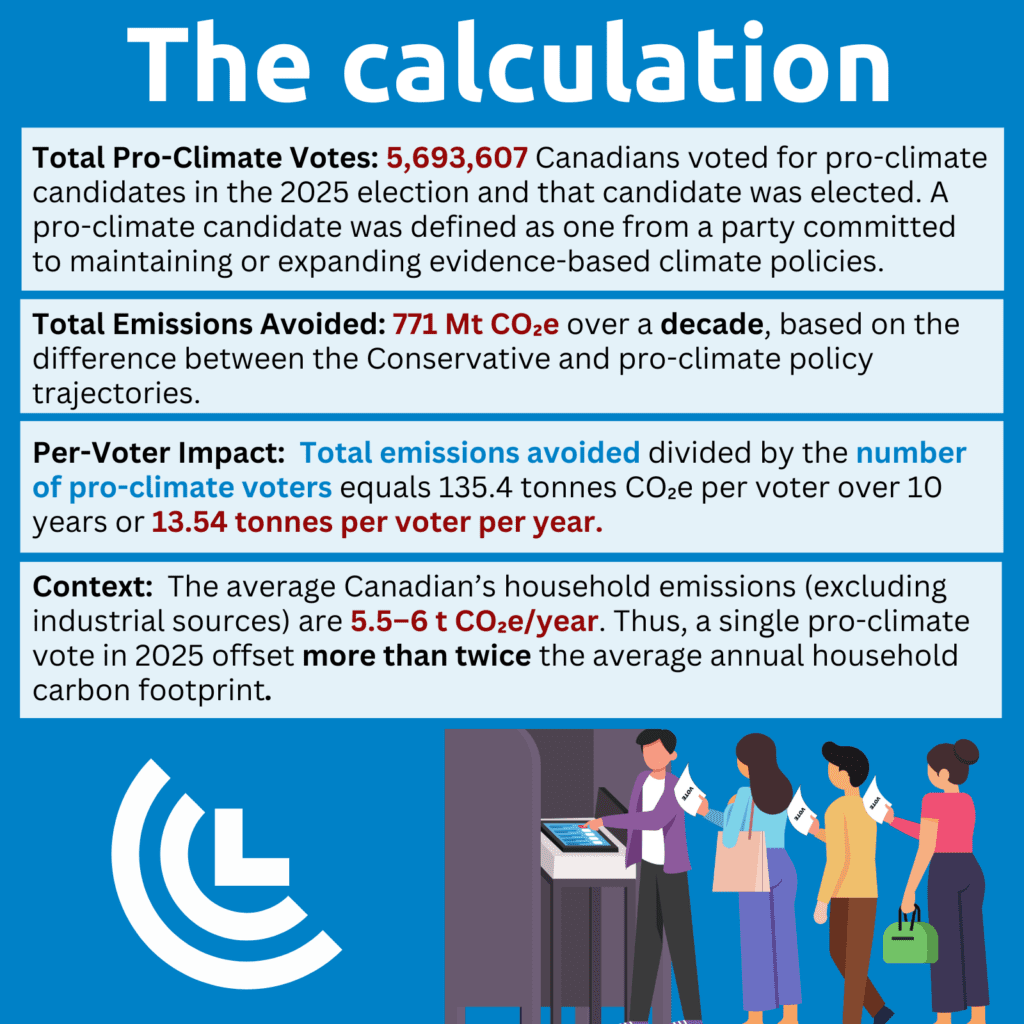
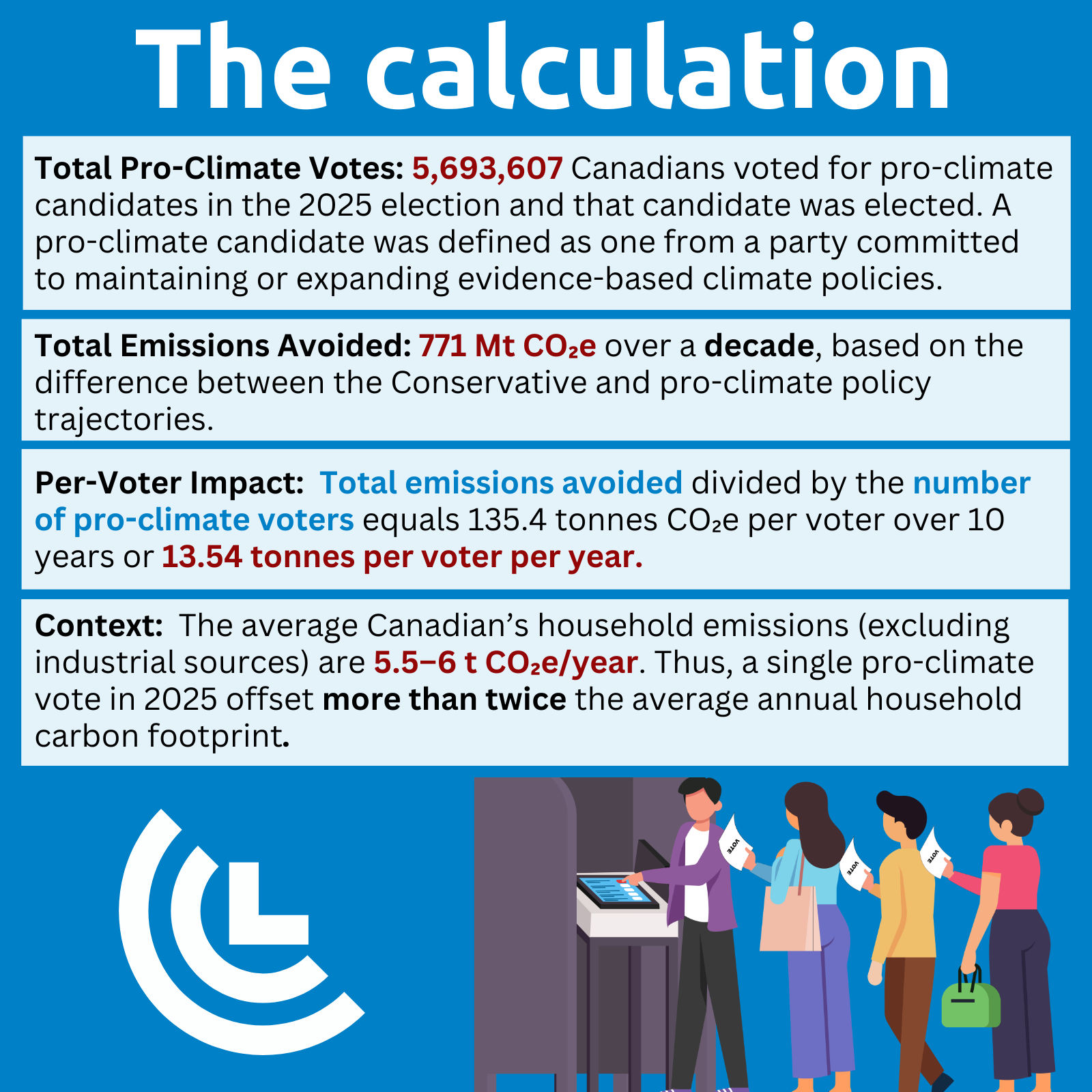
- Total Pro-Climate Votes: 5,693,607 Canadians voted for winning pro-climate candidates in 2025 and that candidate was elected. CCL Canada defined pro-climate candidates as those from parties committed to maintaining or expanding the industrial carbon price and performance standards (Liberals, NDP, Bloc, Greens).
- Total Emissions Avoided: 771 Mt CO₂e over a decade, based on the difference between the Conservative and pro-climate policy trajectories.
- Per-Voter Impact: Dividing the total emissions avoided by the number of pro-climate voters yielded 135.4 tonnes CO₂e per voter over 10 years, or 13.54 tonnes per voter per year.
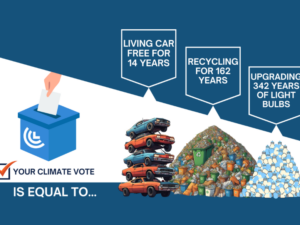
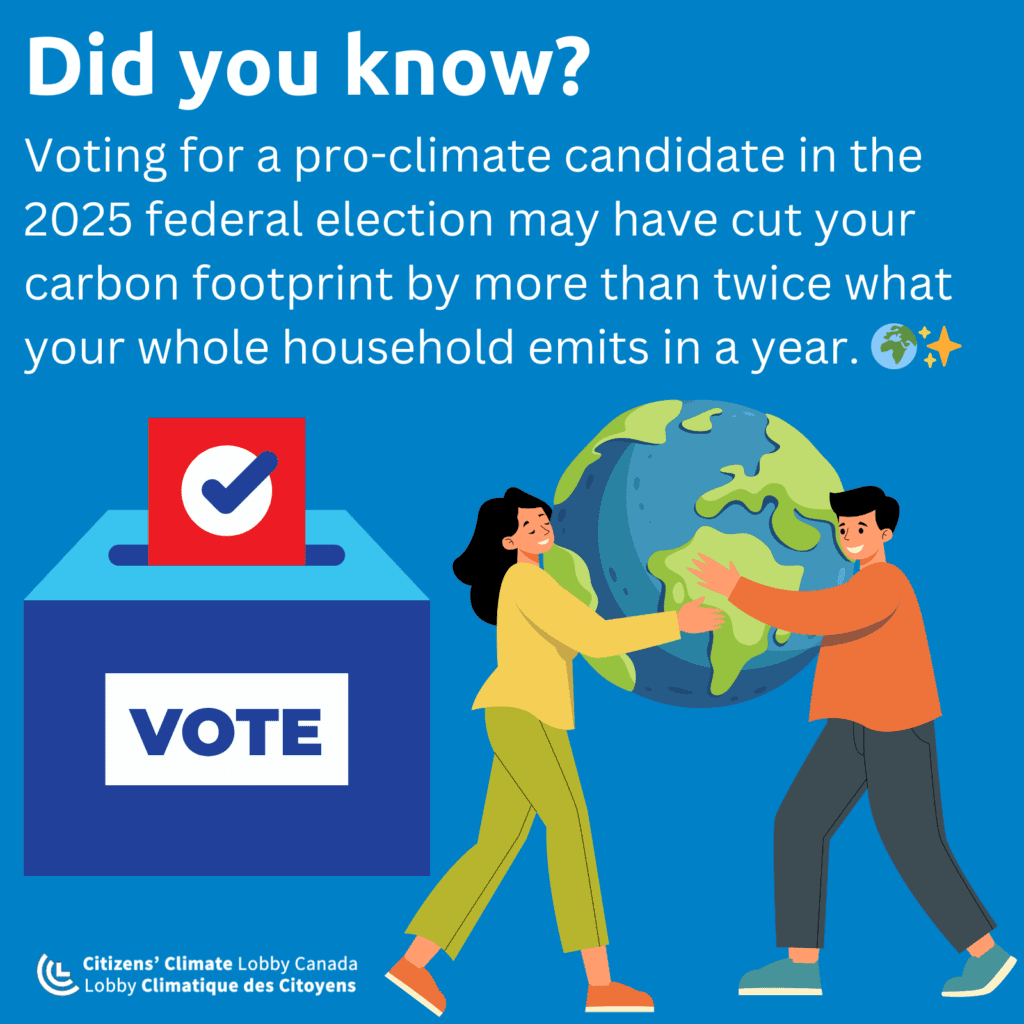
For context, the average Canadian’s household emissions (excluding industrial sources) are 5.5–6 t CO₂e/year. Thus, a single pro-climate vote in 2025 thus offset over twice the average annual household carbon footprint.
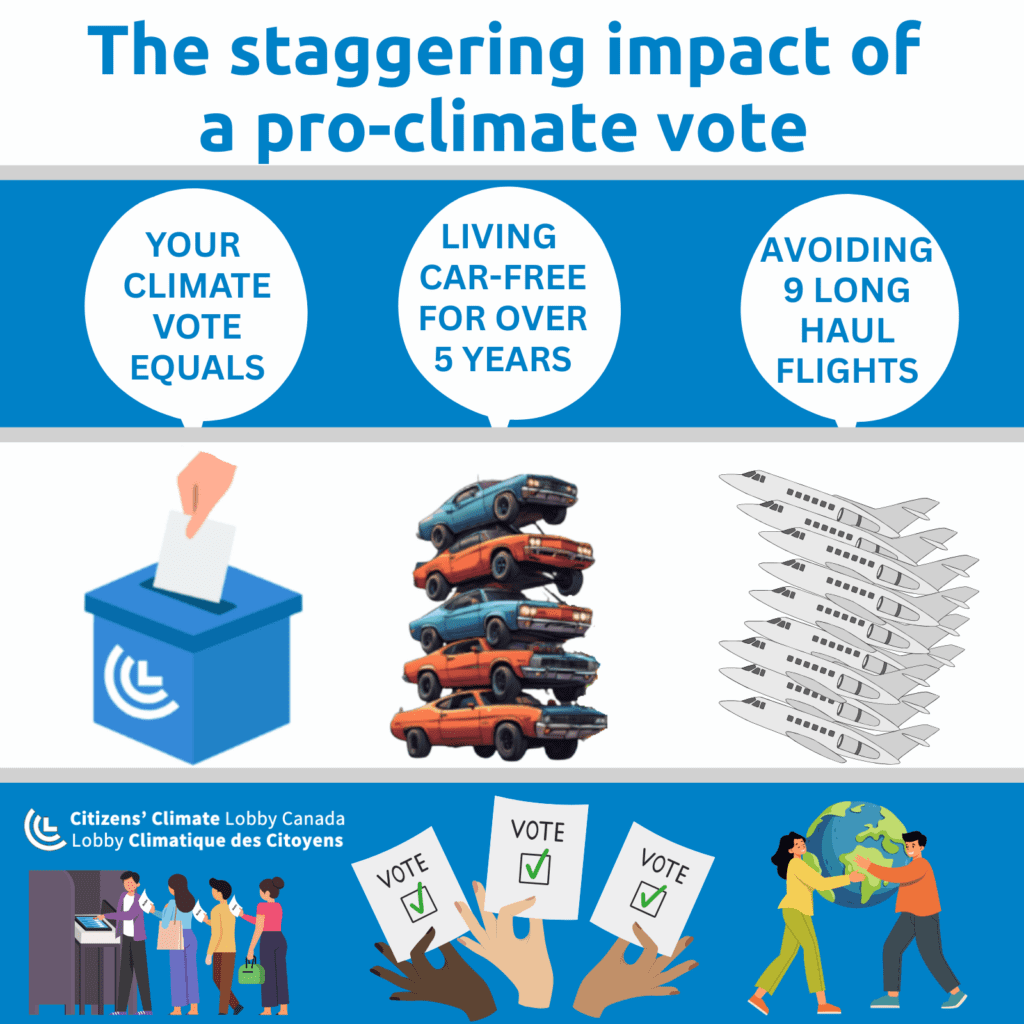
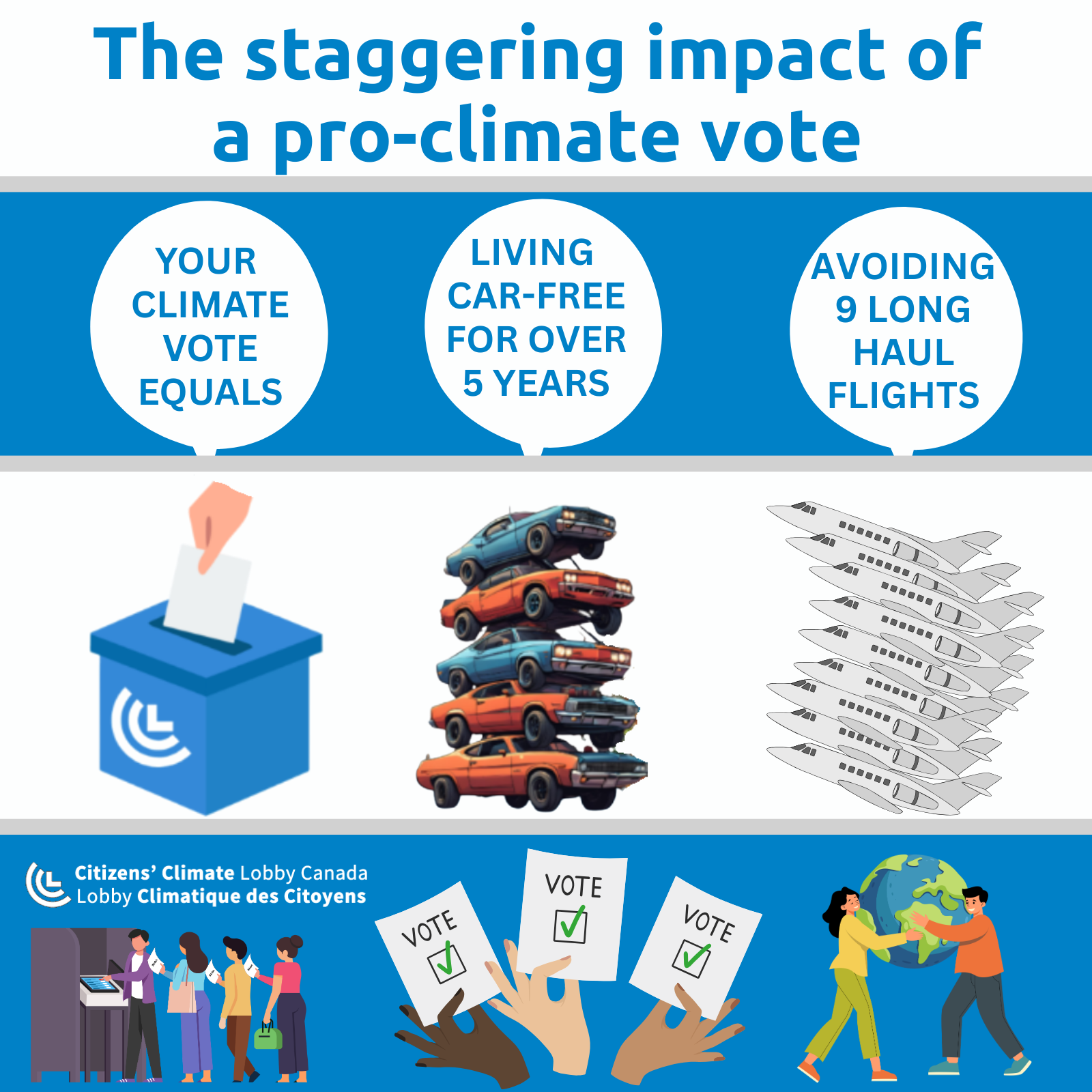
When compared to other individual climate actions, the impact of a pro-climate vote is staggering:
- Living car-free: Avoids ~2.4 t CO₂e/year
- Avoiding a long-haul flight: ~1.4–1.75 t CO₂e
While the 13.54 t CO₂e figure is robust, recent shifts—such as the 2025 federal budget and Alberta MOU—may alter Canada’s emissions trajectory. Further research is needed to update this estimate in light of new policies.
As of December 2025, current policies are projected to reduce emissions by just 21% below 2005 levels by 2030—far short of the 40–45% target and ranked by Climate Action Tracker as highly insufficient.
Yet, the core message remains: voting is a climate game-changer. In a tight parliament, where by-elections and floor-crossings can tip the balance, the collective power of pro-climate votes becomes even more critical.
The 2025 election proved that casting a ballot for a climate-friendly candidate isn’t just a civic duty, it’s one of the most potent tools individuals have to cut global warming gases. For voters, the message is clear: your vote doesn’t just count—it cools the planet.
For more information about how voting cools the planet go here: https://canada.citizensclimatelobby.org/cool-the-planet/
About Citizens’ Climate Lobby Canada Citizens’ Climate Lobby Canada is a non-partisan, grassroots organization empowering Canadians to advocate for effective, equitable climate solutions since 2010.
Media Contact:
Cathy Orlando, National Director
Citizens’ Climate Lobby Canada
cathy@citizensclimate.org | 705-929-4043
#####

Votre vote compte, votez pour le climat !
Comment votre vote aux élections canadiennes de 2025 a permis de réduire les émissions de gaz à effet de serre : une nouvelle étude du Lobby Climatique des Citoyens du Canada
POUR DIFFUSION IMMÉDIATE – Le 18 mars 2026
Sudbury (Ontario), sur le territoire visé par le Traité Robinson-Huron : Le 8 mars 2026, trois élections partielles fédérales ont été déclenchées au Canada, dont celle de Terrebonne, au Québec, où la Cour suprême du Canada avait annulé la victoire remportée d’une seule voix. Ces élections partielles mettent en évidence les marges extrêmement serrées au sein de l’actuel Parlement canadien : le gouvernement libéral, dirigé par le Premier ministre Mark Carney, détient 170 sièges, soit seulement deux de moins que la majorité, depuis que la députée néo-démocrate Lori Idlout a changé de camp le 10 mars.
Compte tenu de l’équilibre des forces si fragile, chaque voix exprimée lors de ces élections partielles revêt une importance capitale, non seulement pour la composition du Parlement, mais aussi pour l’avenir des plans climatiques du Canada.
Une nouvelle étude menée par le Lobby Climatique des Citoyens du Canada (LCC Canada) révèle que les Canadiens qui ont voté pour des candidats favorables à la lutte contre le changement climatique en 2025, et dont le candidat a été élu, auraient réduit leur empreinte carbone personnelle de 13,54 tonnes d’équivalent en dioxyde de carbone (t d’éq. CO₂) par an en moyenne, simplement en contribuant à l’élection d’un député engagé en faveur du climat.
En 2025, le Canada s’est trouvé face à un choix déterminant. Les libéraux, le NPD, le Bloc québécois et le Parti vert ont inscrit dans leurs plateformes le maintien ou le renforcement de politiques climatiques clés, telles que la tarification du carbone pour l’industrie et les normes de rendement. Le Parti conservateur, quant à lui, aurait démantelé le programme de tarification du carbone pour l’industrie, qui coûte environ un Timbit par baril de pétrole, pour le remplacer par une stratégie axée sur l’énergie nucléaire, l’hydroélectricité et le captage du carbone — des approches que les experts jugent insuffisantes pour permettre les réductions drastiques des émissions nécessaires dans des secteurs comme les transports et l’industrie.
Selon des analyses de Stark et Rhodes publiées dans Policy Options et Carbon Brief, une victoire des conservateurs aurait entraîné une augmentation estimée à 771 mégatonnes (Mt) d’éq. CO₂ des émissions du Canada entre 2025 et 2035. Ce calcul tenait compte de l’élimination de la tarification du carbone pour les consommateurs. Ce résultat s’explique principalement par le démantèlement de la tarification du carbone pour l’industrie et des normes de rendement. Le LCC Canada a utilisé ce chiffre comme base au calcul de l’impact climatique de chaque vote.
Pour déterminer les émissions évitées par électeur, le LCC Canada a utilisé l’approche suivante :
- Nombre total de votes en faveur du climat : 5 693 607 Canadiens ont voté en 2025 pour des candidats favorables au climat qui ont été élus. CCL Canada a défini les candidats favorables au climat comme ceux issus de partis engagés à maintenir ou à renforcer la tarification du carbone pour l’industrie et les normes de rendement (Libéraux, NPD, Bloc, Verts).
- Total des émissions évitées : 771 Mt d’éq. CO₂ sur une décennie, sur la base de la différence entre les trajectoires politiques des conservateurs et des partis pro-climats.
- Impact par électeur : La division du total des émissions évitées par le nombre d’électeurs pro-climats a donné 135,4 tonnes d’éq. CO₂ par électeur sur 10 ans, soit 13,54 tonnes par électeur et par an.
À titre de comparaison, les émissions moyennes des ménages canadiens (hors sources industrielles) se situent entre 5,5 et 6 tonnes d’éq. CO₂ par an. Ainsi, un seul vote en faveur du climat en 2025 a permis de compenser plus du double de l’empreinte carbone annuelle moyenne d’un ménage.
Comparé à d’autres gestes individuels en faveur du climat, l’impact d’un vote en faveur du climat est considérable :
- Vivre sans voiture : Évite environ 2,4 t d’éq. CO₂ par an
- Éviter un vol long-courrier : environ 1,4 à 1,75 t d’éq. CO
Bien que le chiffre de 13,54 t d’éq. CO₂ soit fiable, des changements récents — tels que le budget fédéral de 2025 et le protocole d’accord entre le Canada et l’Alberta — pourraient modifier la trajectoire des émissions du Canada. Des recherches supplémentaires sont nécessaires pour actualiser cette estimation à la lumière des nouvelles politiques.
Selon les projections, les politiques actuelles ne permettront de réduire les émissions que de 21 % par rapport aux niveaux de 2005 d’ici 2030, ce qui est bien loin de l’objectif de 40 à 45 % et jugé « très insuffisant » par le Climate Action Tracker.
Pourtant, le message essentiel reste le même : le vote peut changer la donne en matière de climat. Dans un parlement où les rapports de force sont serrés, où les élections partielles et les revirements politiques peuvent faire pencher la balance, le pouvoir collectif des votes en faveur du climat devient encore plus déterminant.
Les élections de 2025 ont démontré que voter pour un candidat favorable à la protection du climat n’est pas seulement un devoir civique, mais aussi l’un des outils les plus efficaces dont disposent les citoyens pour réduire les émissions de gaz à effet de serre. Pour les électeurs, le message est clair : votre vote compte et vous avez un choix sur la lutte au changement climatique.
Pour en savoir plus sur la manière dont le vote contribue à calmer le climat, rendez-vous ici : https://canada.citizensclimatelobby.org/cool-the-planet/
À propos de Citizens’ Climate Lobby Canada
Citizens’ Climate Lobby Canada est une organisation non partisane et citoyenne qui permet aux Canadiennes et Canadiens de plaider en faveur de solutions climatiques efficaces et équitables depuis 2010.
Contact médiatique :
Cathy Orlando, Directrice nationale
Citizens’ Climate Lobby Canada
cathy@citizensclimate.org | 705-929-4043
More information
More references
- Starke, E., & Rhodes, K. (2025). GHG emissions likely to rise if Conservatives win April 28 election. Policy Options. https://policyoptions.irpp.org/2025/04/climate-comparison-conservative-election/
- Gabbatiss, J. (2025). Analysis: Conservative election win could add 800m tonnes to Canada’s emissions by 2035. Carbon Brief.
https://www.carbonbrief.org/analysis-conservative-election-win-could-add-800m-tonnes-to-canadas-emissions-by-2035/ - Citizens’ Climate Lobby Canada. (2025). Climate action counts 2025. https://canada.citizensclimatelobby.org/climate-action-counts-2025-2/
- Standing Committee on Environment and Sustainable Development. (2023). Report 10:Unleashing technology not taxes] (44th Parliament, 1st Session). House of Commons. https://www.ourcommons.ca/documentviewer/en/44-1/ENVI/report-10/page-108
- Marstokk, A., et al. (2024). Which Canadian climate policies will have the biggest impact by 2030? Navius Research.
https://www.naviusresearch.com/publications/climate-policy-impacts-2030/ - IPCC. (2023). AR6 Working Group III – Chapter 13.
https://www.ipcc.ch/report/ar6/wg3/chapter/chapter-13/ - Our world in numbers https://ourworldindata.org/profile/co2/canada
- Thurton, D. (2025, December 17). Canada’s 2030 climate target far out of reach, according to federal data. CBC News. https://www.cbc.ca/news/politics/emissions-reduction-plan-greenhouse-gas-projections-9.7020385
- Statistics Canada. (2025). Canadian System of Environmental–Economic Accounts: Energy use and greenhouse gas emissions, 2023.
https://www.canada.ca/en/services/environment/weather/climatechange/climate-plan/climate-plan-overview/emissions-reduction-2030/2025-progress-report.html - Wynes, S., Motta, M., & Donner, S. D. (2021). Understanding the climate responsibility associated with elections. ScienceDirect, 4(3), 363–371.
https://www.sciencedirect.com/science/article/pii/S2590332221001147
- Climate Action Tracker. (2026). Canada. https://climateactiontracker.org/countries/canada/
Carbon Footprint Calculations
Carbon Footprint Calculations:
Living Car Free: Total on-road passenger vehicle emissions in Canada were 91.4 Mt CO₂e in 2018, with about 25 million registered passenger vehicles (Statistics Canada). This averages to roughly 3.6–4 tonnes CO₂e per vehicle per year, depending on the year and vehicle mix. Note: Adjusting for per capita (assuming ~2 people per car) brings the estimate to ~2.4 tonnes CO₂e/year per person.
https://tc.canada.ca/en/corporate-services/transparency/corporate-management-reporting/transportation-canada-annual-reports/2020-2021/green-transportation
Avoiding Longhaul flights: Organizations like Carbon Independent and MyClimate provide calculators and data showing that a one-way long-haul flight (e.g., New York to Paris) emits about 0.7–0.9 tonnes CO₂e per passenger, making a round-trip 1.4–1.8 tonnes CO₂e.
https://www.carbonindependent.org/
https://www.myclimate.org/
Calcul de l’empreinte carbone :
Vivre sans voiture :
En 2018, les émissions totales des véhicules de passagers sur route au Canada s’élevaient à 91,4 Mt d’équivalent CO₂, avec environ 25 millions de véhicules de passagers immatriculés (Statistique Canada). Cela représente en moyenne environ 3,6 à 4 tonnes d’équivalent CO₂ par véhicule par année, selon l’année et le type de véhicules. Remarque : En ajustant par habitant (en supposant environ 2 personnes par voiture), l’estimation passe à environ 2,4 tonnes d’équivalent CO₂ par personne par année.
https://tc.canada.ca/en/corporate-services/transparency/corporate-management-reporting/transportation-canada-annual-reports/2020-2021/green-transportation
Éviter les vols long-courriers :
Des organismes comme Carbon Independent et MyClimate proposent des calculateurs et des données indiquant qu’un vol long-courrier aller simple (par exemple, New York à Paris) émet environ 0,7 à 0,9 tonne d’équivalent CO₂ par passager, ce qui porte un aller-retour à 1,4 à 1,8 tonne d’équivalent CO₂.