

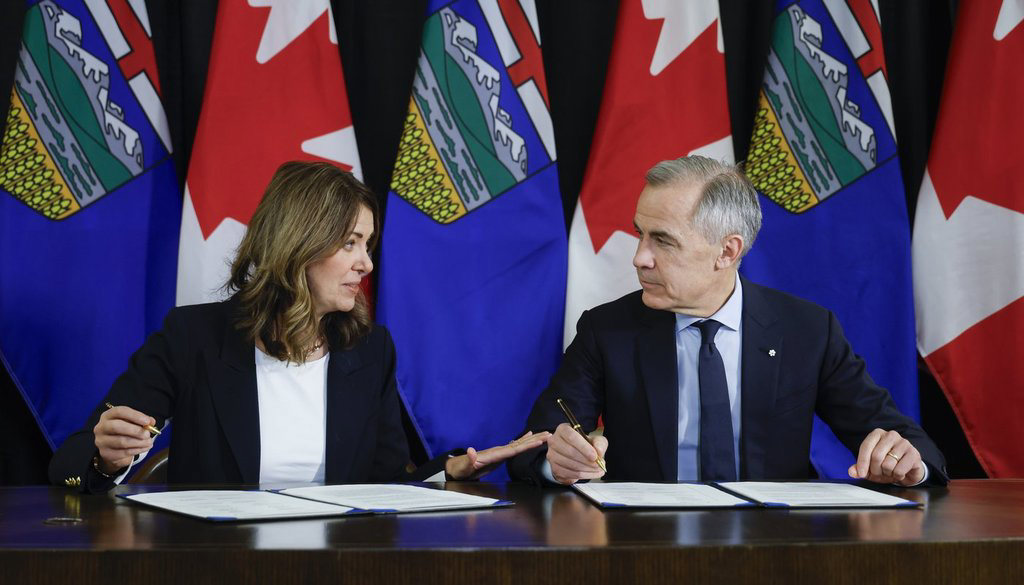
New analysis from Navius Research reveals a stark truth: the Canada-Alberta MOU overhauls climate policy for 40% of Canada’s emissions, yet leaves our long-term emissions trajectory largely unchanged. Across modelled scenarios, annual emissions range from roughly 7 Mt below to 9 Mt above, what existing policies would have delivered before the MOU was negotiated (approximately -160Mt by 2030). https://climateinstitute.ca/wp-content/uploads/2026/02/Climate-Institute-440-Megatonnes-Independent-Assessment-2026-2025-Progress-Report-2030-Emissions-Reduction-Plan.pdf Policy changes fall short. Despite a major redesign, emissions outcomes remain on par with today’s path—or worse. The MOU weakens market fundamentals while claiming to strengthen Alberta’s carbon market. Benchmark tightening rates are slashed in half, drastically reducing compliance demand and undermining the market’s ability to drive reductions. The price floor’s design abandons market-driven price discovery in favour of fixed prices, creating a system that asks too much of the floor while delivering too little in actual emissions cuts. The emissions math doesn’t add up. Expanded pipeline capacity and increased oil production will add about 20 megatonnes of annual emissions to Canada’s total. The MOU’s other policy changes won’t fully offset this increase, leaving Canada’s emissions trajectory stubbornly high well into mid-century. And the market has spoken. Since the MOU’s finalization, Alberta carbon credit prices have fallen by almost 25%, signalling that market participants expect materially looser conditions ahead. This is a clear vote of no confidence in the agreement’s ability to drive meaningful change. The takeaway: A sweeping policy shift with little to show for it on emissions. Canada needs bolder action to meet its climate goals. The MOU: Emissions Unchanged, Goals Unmet
(Navius Research, June 4, 2026)
https://440megatonnes.ca/insight/canada-alberta-mou-leaves-emissions-largely-unchanged/
https://www.qcintel.com/carbon/article/carbon-compromise-puts-short-term-pressure-on-tier-credits-65434.html



FOLLOW AND JOIN US
 |
 |
 |
 |
 |
 |
Annual National Planning Sessions
Jan 2026: Standing Our Ground V
Jan 2025: Standing Our Ground IV
Jan 2024: Standing Our Ground III
Jan 2023: Standing Our Ground II
Jan 2022: Standing Our Ground I
RESOURCES
Laser Talks Page
Monthly Actions
LAND ACKNOWLEDGEMENT
CCL Canada respectfully acknowledges that the work we support stretches across the homes of many First Nations, Métis and Inuit peoples on Turtle Island and that their traditional knowledge must be significantly incorporated as part of meaningful action on the climate crisis. We acknowledge that they are traditional owners and custodians of this land and that for decades they have been the first line of defence against climate breakdown. Indigenous resistance has stopped at least 1.8 billion metric tonnes of greenhouse gas pollution on Turtle Island