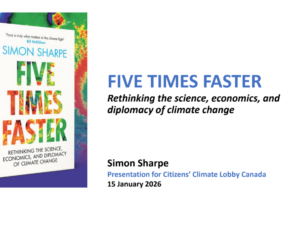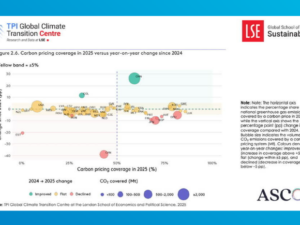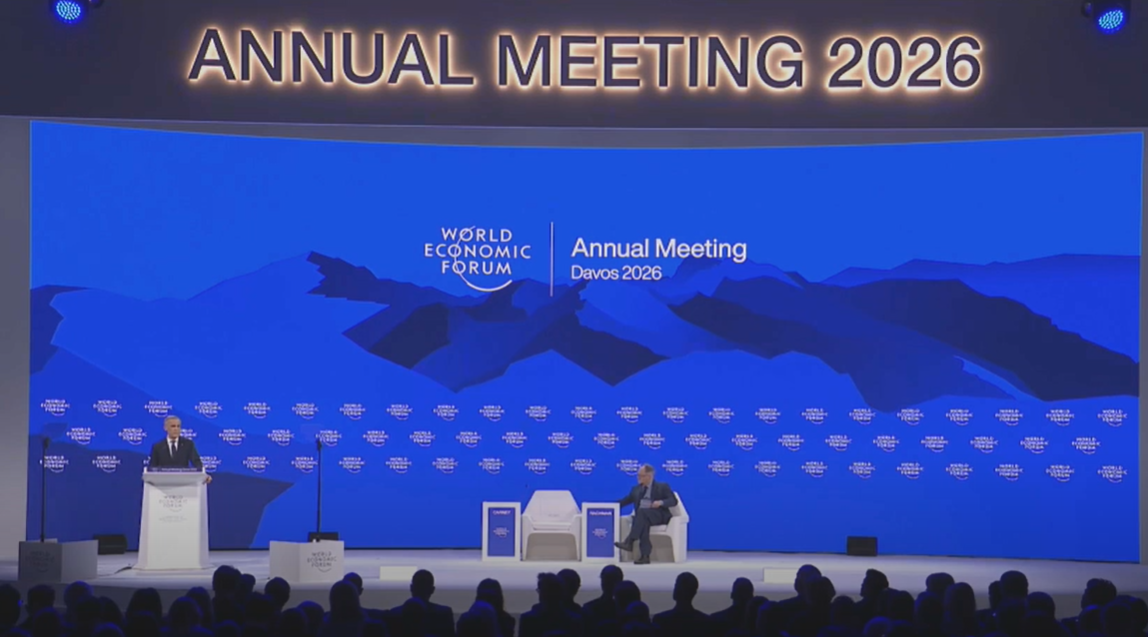
For Immediate Release: January 21, 2026 SUDBURY, ON in Robinson Huron Treaty Territory – This week at the World Economic Forum in Davos, two starkly different worldviews collided. On Tuesday, Prime Minister Mark Carney warned that the world is “in the midst of a rupture of world order,” arguing that the rules-based international system has fractured and that middle powers must act together or risk subordination. One day later, U.S. President Donald Trump declared that “Canada lives because of the United States,” reinforcing a worldview rooted in dominance, coercion, and zero-sum thinking. Taken together, these statements reveal a deeper truth: the global economy is not a stable system in equilibrium. It is operating in dynamic states that are and will be shaped by tipping points, feedback loops, and rapid, nonlinear change. For decades, economic and political decision-making has been guided by theories with a fundamental flaw. They assume equilibrium. That assumption produces incremental change, marginal gains, and burden-sharing framed as losses to be minimized. In this static worldview, international cooperation is treated as a zero-sum game. If one country gains, another must lose. But that is not how complex systems such as economies behave under stress. In complex systems, from climate and energy to technology and geopolitics, ruptures occur when old negative feedback loops break down and new positive feedback loops take over. Once a tipping point is reached, change accelerates along an S-curve: slow at first, then rapid, and finally self-reinforcing. This is why today’s geopolitical tension cannot be solved by simply reasserting control. Trump’s rhetoric reflects an attempt to impose dominance on a system that no longer responds predictably to force. Carney’s warning acknowledges reality. We are not managing a smooth transition. We are navigating a period of chaotic adjustment in which outcomes depend on where and how we intervene. That reality demands new economic thinking. As articulated by economist Simon Sharpe, author of Five Times Faster, transformation of the economy must be approached sector by sector, focusing on actions that trigger positive feedback loops now, not at some distant equilibrium point. When clean technologies scale, costs fall. When costs fall, adoption accelerates. When adoption accelerates, political resistance weakens. These are not abstract theories. They are observable dynamics already reshaping energy, transport, and manufacturing. Solar adoption in China and Pakistan provides a clear example. Once costs dropped and deployment accelerated, solar became the economically rational choice, not a moral one. The system tipped, and momentum followed. Crucially, this transformation does not require unanimity. History shows that progress accelerates when a coalition of the willing moves first. Sharpe’s data are clear: a global transition to a clean energy future is achievable with cooperative leadership from Canada, the European Union, the United Kingdom, China, and California-aligned U.S. states. Once these actors tip key sectors onto the steep part of the S-curve, others follow, not out of altruism, but because the economics change and participation becomes advantageous. This is positive-sum thinking grounded in real-world system behavior and cooperation, not ideology. “For me, this framing makes profound sense,” says Cathy Orlando, National Director of Citizens’ Climate Lobby Canada. “I hold a master’s-level science degree in physiology, where we were trained to understand equilibrium, dynamic states, and tipping points. For the past quarter century, my email sign-off has read: ‘If you want to be incrementally better, be competitive. If you want to be exponentially better, be cooperative.’ That insight applies as much to economies and geopolitics as it does to biological systems. As Simon Sharpe has explained, the economic transition to a climate-safe future can happen five times faster when these dynamics are applied.” In a world defined by rupture, clinging to zero-sum narratives is not strength. Attempts to dominate rather than cooperate lock countries into defensive postures that slow innovation and amplify instability. The alternative is strategic realism: act early by strengthening domestic economies, focus on sectors where tipping points are within reach, and build coalitions capable of shifting the system as a whole. The question facing Canada and the world is not whether we can return to the old equilibrium. That equilibrium is gone. The real choice is whether we shape what comes next through cooperation and positive feedbacks, or allow coercion and zero-sum thinking to push us deeper into chaos. Canada is already moving in the right direction. As Prime Minister Carney said in Davos, “Nostalgia is not a strategy.” Media Contact: #### This week in Davos: Zero‑Sum Thinking Is Not Strength
Citizens’ Climate Lobby Canada urges cooperation and real-world solutions to accelerate a climate-safe future.
Cathy Orlando, National Director
Citizens’ Climate Lobby Canada
cathy@citizensclimate.org | 705-929-4043